Category: Old

  • The Genetics of Ethnicity

    Following an introduction to the idea that we actually have no genetic relationship with many of our direct ancestors, we will consider what this means for the promise from genetic-testing companies of finding your “ethnic heritage.”
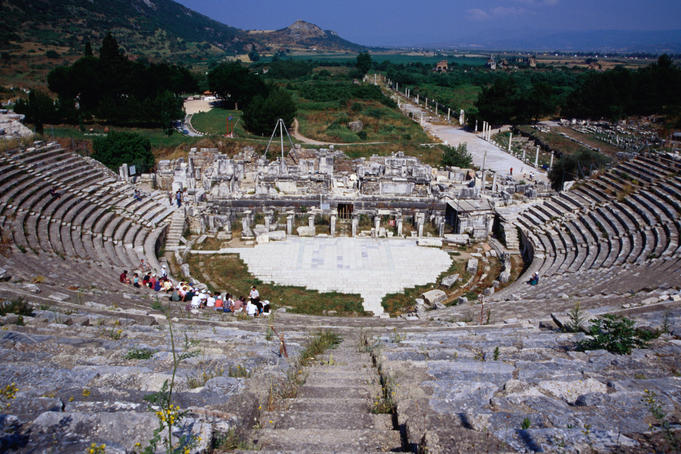
    Amphitheater in Ephesus (Efes), Turkey
    Amphitheater in Ephesus (Efes), Turkey

    Imagine that you are on a theater stage, like the one pictured. You are standing in a theater modeled after the Greek and Roman amphitheaters that survive as ruins across the Mediterranean. There is stadium seating for your audience, so that each rank away from the stage is placed about a foot or two above the preceding. Because the amphitheater stretches up and away from you in a rounded bowl shape, each row from the stage has more seats than the one before it.

    The first rank of the audience is very unique to you: it seats only your mom and dad. To be more specific, it is your biological father and your biological mother. They have the entire front row to themselves, but stretching back behind them the rows become ever more crowded.

    Behind your parents are their parents, in the second row back from the stage. In the third row back from the stage, as you might have guessed, sit their parents– your eight great-grand-parents gathered to see you perform. In the fourth row back sit their parents — your sixteen great-great-grandparents, possibly somewhat confused as to what the fuss is all about.

    If we stop there, we can make some observations about your relationships, genetic and otherwise. For starters, there are no siblings present, no step- or half-parents or siblings. Here we see only the most strictly defined idea of parentage. What’s more, we can be fairly certain (to a degree approaching, but not quite, 100% certainty) that you share some human-specific genetic material in common with everyone in the first four rows.

    Moving back in the amphitheater, let your gaze move beyond the crowd closest to the stage. In the fifth row sit the parents of your sixteen great-great-grandparents, your thirty-two great-great-great-grandparents. Here we can see a new class of audience members; from this point on, you will find fewer and fewer relatives that have left a trace in your personal DNA. And back and back the amphitheater stretches, each row with double the number of ancestors, reaching a maximum of around two or three million unique ancestors before the population shrinks down to our common ancestors — the first modern humans.

    So your ancestors are not related to you? They are, and they are not. They are related to you genealogically, but not necessarily genetically. You exist because they existed (and had children who did the same). They are your direct ancestors, directly above you on your family tree. They are a part of your family. But, still, their human-specific DNA can easily be absent from your own.

    To think precisely, we need precise terminology. The terms “gene” and “genetics” can mislead. For example, it is incorrect to say that “we get fifty percent of our genes from each parent” because we actually receive one hundred percent from each parent. Each human being has the same genetic code, after all. This is why mapping “the human genome” is useful — each of us has the same genes. What is individual to each person is the system of alleles.
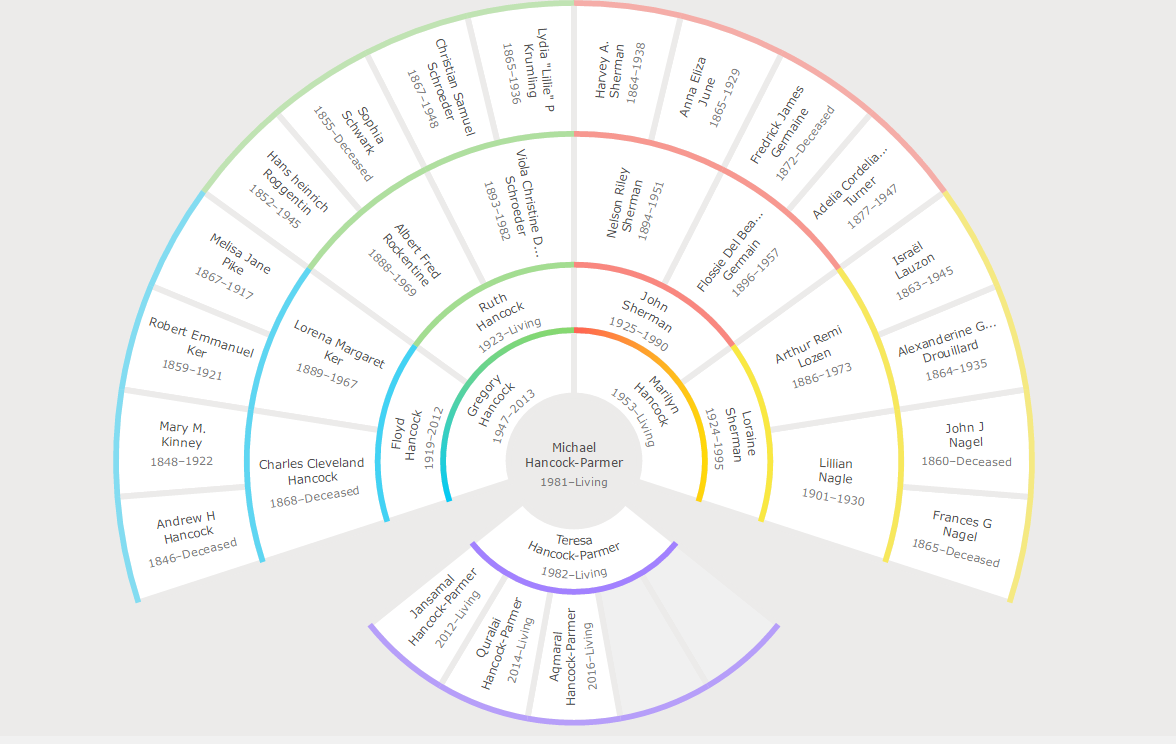
    Family Tree Amphitheater
    My family tree
    Assumed relationship by generation

    Exactly fifty percent of your alleles come from your mother, and the other fifty from your father. Put another way, fifty percent of your alleles come from your mother’s family, and fifty percent from your father’s family. Your mother and father in turn received fifty percent from each of their parents… This leads us to incorrectly assume that we receive twenty-five percent from each grandparent, twelve-and-a-half from each great-grandparent, and so on. In reality, however, when you have a child, you are not passing on exactly half of your mother and half of your father! Your DNA is not an even four-way split between your grandparents.

    Why? Because when you received your fifty percent of your alleles from your mother,  it was not evenly divided between her mom and dad. In other words, in the act of sexual reproduction, half of your genes come from your father and half from your mother, but that half is determined by that specific egg or that specific sperm. For example, each egg is genetically distinct, a different combination of alleles from your mother’s mother and your mother’s father. Each egg was created differently through the act of recombination.

    One of the logical results of this variation in the genetic material we receive from our parents is counter-intuitive and very surprising – so I will underline it. 

    There is a low, but non-zero, chance that one parent gave you the alleles from only one of their parents and not-a-one from the other… making you unrelated to one of your grandparents!

    In other words, you are not equally genetically related to each of your four grandparents. It is possible, even statistically likely, that you are barely related to one or more of your great-grandparents. Once we get beyond that into great-great-grandparents, it becomes statistically unlikely that you share genetic traits with each of them. Again, in the extreme, you may not even have such traits in common with one of your parent’s parents!
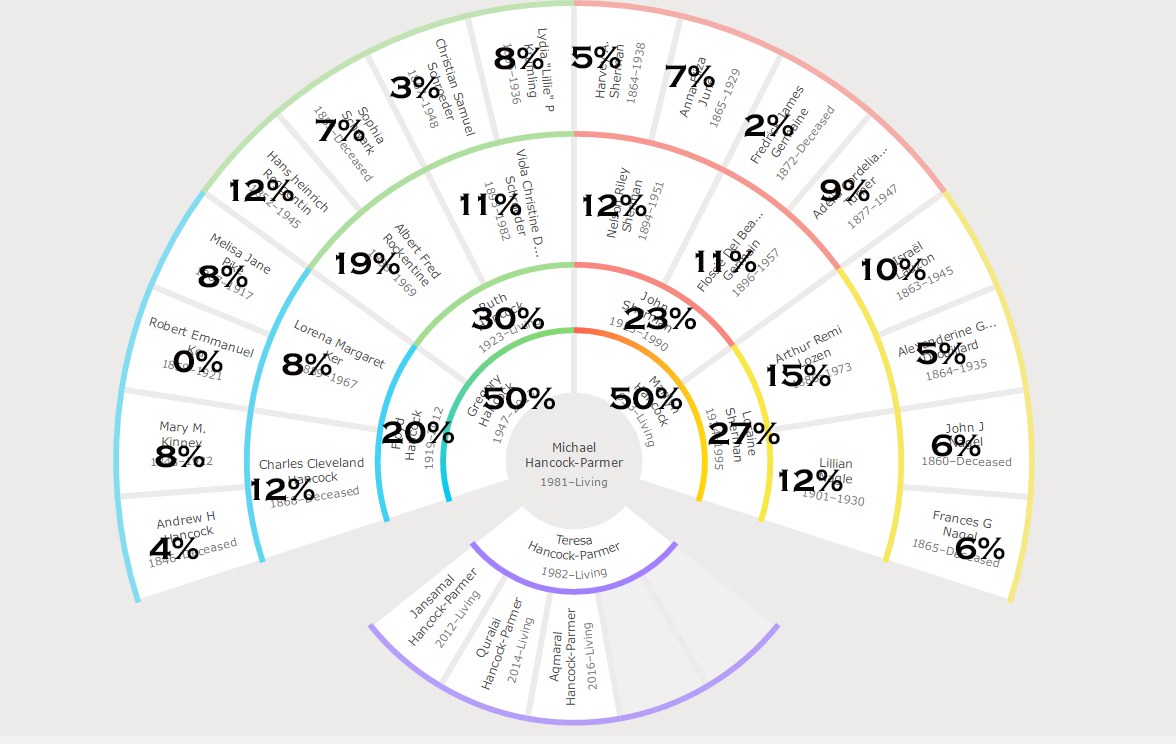
    Possible percentages of relationship by generation
    Possible percentage of shared alleles with my family tree

    This is much more common than most realize! Geneticists estimate that once in every four million births, a child has no genetic relationship with one of their grandparents. In the United States alone we might expect to find some 80 people in that situation. The likelihood increases dramatically when we only consider the alleles that we can see with the naked eye: the shape of your nose, the pattern of your freckles, the color of your eyes. Science, then, agrees with reality. How often have some cousins noticed that they share a stronger resemblance with each other than with a sibling?

    The past is gone. If ethnic identity was formed in the past, how does it still hang around? Answer: because it is constantly reinvented in the present by those alive in the present.  That the past is no longer present is difficult to accept for many people. We recapture the past using many resources — memory, the written word, ruins, and legends. These sources offer glimpses of the past, with limited accuracy. In other words, the past is not a very safe place to store one’s identity.

    When companies like 23andme, Ancestry.com, National Geographic, Helix.com, and MyHeritage.com offer to explain (sell?) our identities to us, we should understand the insurmountable limitations they face in doing so. This is especially important to remember considering that these companies charge a lot of money to analyze cheek-moistened Q-tips (starting around $80 and moving upward of $500, depending on the services purchased).

    Example of DNA advertisement found in the wild

    There are three genetic tests on offer: testing Y-chromosomal history (available only to holders of Y-chromosomes, i.e., “biologically-defined men”), testing mitochondrial DNA (mtDNA), and testing your alleles, your “autosomal DNA.” The first two are very specific: Y-chromosome tests reveal only your patrilineal descent, while mtDNA only reveals your matrilineal descent. Both the Y-chromosome and the mtDNA is passed between generations with very few mutations or changes, making them useful for archaeologists and less useful for genealogists. For example, thanks to mtDNA and Y-Chromosome testing, geneticists have estimated that the most recent common ancestor for every human being on earth possibly lived only 2000 years ago.

    Parts of your family tree visible to genetic tests.  After only a few generations, these tests are telling you about a vanishingly small minority of your ancestors.  

    Haplogroups refer to these two types of tests. They derive from the slow mutation of the Y-chromosome and mtDNA — changes that happen very rarely. In the case of mtDNA, scientists in one study observed an average of 1 mutation (“substitution”) per thirty-three generations, though skepticism remains because the observed rate in genetic studies is much, much slower [quoted here]. Y-chromosomes mutate considerably faster. However, both mtDNA and Y-chromosomes change much more slowly than the genome at large, which is scrambled and re-assembled every generation — so that both of these are used to signify “haplogroups” by geneticists, showing general relationships over large populations.

    Genetic haplogroups are not synonymous with ethnicities, races, nationalities, religions, or other identities. 

    Indeed, Y-chromosome haplogroups and mtDNA haplogroups are quite different (examples HERE and HERE) and do not add new information for the consumer of genetic testing — they largely confirm (or at least do not contradict) the Out-of-Africa hypothesis of human prehistory.

    It is the third test that allows people to find more recent relationships and connections with “ethnic identity.” Unfortunately, such tests are limited to the above percentages — what do you do with the fact that so many of your recent ancestors (some of whom lived only 100 or 200 years ago) are not even present in your DNA? Ancestry.com divided the world up into 26 ethnic/genetic provinces, each determined by small samples, sometimes as few as a dozen, rarely more than 100. [Quick read on this here…]

    And who is representing these ethnic identities? 23andme and similar companies state that if a subject has been genetically tested and affirms that their four grandparents were from a specific location, that person today is counted as a “native” of that location. In other words, when your genetic results claim that you are 57% Northern European, they mean that your markers have so much in common with the people currently living there… but again, what about their own genetic heritage? They, too, have many in their past whose DNA is absent from the present.

    The fact is that the computer analyzing your DNA does not spit out your “identity,” but rather a long string of numbers and letters. This string is in turn analyzed by an algorithm searching for matches in a growing (but finite) database. That matched information is then sent on to a human being to interpret — and this is key. Should you send the same DNA to multiple testing sites, you will find different ethnic backgrounds! For more information on the process of interpretation, see this website. How does this happen?

    Simple answer: because ethnicity is not based on science. Science can measure and explain the chemical makeup of your DNA, but it cannot (should not?) measure and explain your genealogical, “ethnic” identity. And much of this science-and-identity is unfortunately filtered through profit-driven companies, to boot…

    So, can you tell your ethnic identity from a DNA test? No, not the way you think it can…

    If you would like to read examples of the kind of literature I am criticizing in this article, you will find links in this paragraph. Works suggesting that genetics support or prove ethnic identity are commonplace, but I argue they are misleading at best and nationalistic hate-speech at worst. There are, sadly, more iterations of this argument than I can count: you can start HereHereHereHere or Here – and of course the options increase if we search outside the body of English language materials.

  • New World Demographics

    As the result of teaching many years of introductory college history courses, I have tried to keep fresh in the literature. In teaching this course, I have begun to think that the history of Native Americans in the United States is missing a very important conclusion from the data: that our understanding of “tribal society” represents not an age-old practice, but rather the recently produced consequences of massive die-off and the disappearance of a larger, less scattered, and in some cases decidedly urban population.

    Similar to other professors of history, I teach a class called Western Civilization stretching in one semester from ancient times up to the year 1500 and the arrival of Columbus on the fringes of the New World. However, rather than stop dead in our tracks, we spend the last two lectures discussing the reputation and legacy of Columbus through the lawsuits his family endured to protect their rights to their inheritance, and putting the Black Death (covered earlier in the semester) in context by comparing it with the much larger loss of life in the centuries after the arrival of the Europeans to the Americas.


    From the Codex Azcatitlan, showing an indigenous rendering of the arrival of the Spaniards in 1519 led in front by Cortés, guided by Malinche.

    I am particularly interested in the career of Hernando de Soto (c. 1495-1542), who wandered the southern North American continent for several years with a pillaging army before he died of a fever.

    Typical map showing Hernando de Soto’s route (1539-43), showing modern state borders, modern cities and describing the region as “the wilderness,” omitting cities described by Soto.

    Their accounts of densely populated areas were considered wildly inaccurate when Europeans came again to the same areas more than a century later.  This offers an enticing glimpse into the surviving descendants of the inhabitants of Cahokia and the broader Mississippian urban culture of the centuries prior to 1500.  While Soto found a large population still living in the area, there is also the possibility that some, maybe most, of the inhabitants of the cities of and around Cahokia where those mentioned in the origins of the Aztecs, coming from the fabled Aztlan (Aztec, in the Nahuatl language, has been rendered into English as “people from Aztlan”).


    Aztecs leaving Aztlan in an image originally interpreted by some Europeans to suggest they were survivors of Atlantis, but later observers considered proof of Aztecs coming from Florida or the Caribbean. This is from a copy of the Codex Boturini, painted by an unknown Aztec in the 1530s, from its first page (fol. 1). The original was uncolored, using only black ink.

    Having drawn these conclusions, I have looked for others who have had the time and expertise to articulate these ideas better than me. For a quick read, I recommend this piece in The Atlantic,1491. The best long-form book I have found so far is Born to Die: Disease and New World Conquest, 1492-1650 by Dr. Noble David Cook, published by the Cambridge University Press in the late twentieth century. At the time it was hailed as a challenge to the traditional view that the massive loss of life could largely be blamed on the excesses and exploitation specific to Spanish (versus English or French) colonialism, an idea still widely entertained, though long since challenged by professional historians. Two valuable aspects of Dr. Cook’s book that strike me at this moment are his reliance on the contemporary source material from the sixteenth century and his detailed tracing of the history of how differently people in different eras have tried to answer one specific question: how did a handful of Europeans conquer and annihilate two massive, urbanized civilizations, the Aztecs and the Incas? The many ways in which this question has been answered have a lot to teach us. From Dr. Cook’s analysis of the contemporary material, he argued convincingly that disease arrived already with Columbus’ second voyage, much earlier than the more famously discussed small pox outbreak of 1513. The only real shortcoming of the work is specifically in the area that I have been interested in: Dr. Cook did not extend his analysis to the effects of this cluster of epidemics to the North American continent.

    Allow me to hazard some specifics to flesh out my educated guess.

    When Europeans moved into North America in the sixteenth century, the people they encountered were the handful of survivors of a series of epidemics causing a loss of life greater than fifty percent of the population, perhaps as high as eighty or even ninety percent. No matter the specifics, there were survivors and even examples of total village annihilation. In some parts of the continent, relatively small communities survived more intact due to their remoteness… but this same remoteness led them to be relatively unfamiliar with the larger communities from which they were estranged. These survivors banded together, struggling to make do with the new reality, its difficulties, and the loss of their earlier way of life made possible by larger populations. The growth rate of these survivor populations was relatively slow at first, but increased with the arrival of the settler populations, so that swiftly the two groups came into direct competition over the limited resources of individual areas of the continent. The later arriving Europeans in the eighteenth and nineteenth centuries saw these tribal, atomized, scattered societies and their practices and assumed their comparatively primitive lifestyle was the result of something other than massive die-offs in the sixteenth century. Due to the massive cultural loss caused by the swift destruction of 80-90% of the indigenous population, large sections of their previous history were reduced to legend, or worse, total oblivion. The indigenous, within six or eight generations, when their histories were being recorded in large numbers for the first time, weaved a tale that explained their current situation: They had always lived in the way they were living in the nineteenth century, even as some of their European observers corrected them with the earlier written accounts recorded by their distant ancestors in the seventeenth century.

    I am borrowing maybe too freely from James Scott’s The Art of Not Being Governed. Scott has argued at length about the need to re-evaluate those living in stateless areas, the “uncivilized” populations of hillbillies and mountain people so widely disregarded by urbanized, civilized populations. I, and other historians, have successfully used Scott’s arguments in places far flung from his original research area of Southeast Asia, but using them to discuss the remnants of a crumbling preColumbian culture is perhaps a bridge too far.

    In terms of the loss of cultural memory, allow me to risk some analogies to ancient history. The example that I find most useful pertains to Ancient Greece and the fact that the Greeks, in two different scenarios separated by centuries, developed a written language. Centuries before Homer and the tales of Odysseus and Achilles, speakers of a language closely resembling Ancient Greek began to use an alphabet known to linguists as Linear B, which they borrowed from speakers of an older and (as-yet) undecipherable language written with an alphabet called Linear A. However, during the twelfth century before Christ, there occurred a series of calamities historians have dubbed the Bronze Age Collapse. The civilization of these pre-Homeric Greeks, the Mycenaeans, entered a decline and quickly stopped using Linear B to record their words. For centuries, no Greek language was recorded at all — a period referred to as the Greek Dark Ages, during which the historical Homer (or similar bards) composed the epic poetry many students still study in High School. Not until the eighth century before Christ do we see evidence of the Greeks writing Greek again, now in the Phoenician alphabet, supposedly with zero knowledge or understanding of these older pieces of writing.

    Linear B tablet KN Fp 13, dated to 1450-1375 BC, records, in Greek, oil offered to certain gods.

    One of the aspects of this line of questioning I find most distressing is how a descendant of one of the indigenous of this continent may read it. While I am attacking the basis of the “savage Indian” tropes, I am also calling into question the age-old defense of age-old harmony and eco-friendly tribes living “as one with nature,” the kind of saccharine depictions lampooned in Disney’s Pocahontas (1953) and to a lesser degree in the film The New World (2005). I am suggesting something attractive, I hope – true human equality, populations sharing the same sins and the same blessings, the same ability to live both ‘with nature,’ and also to shape it to one’s advantage. In this avenue of thought, I have great company, including: those studying the possibility that the Amazon rain forest is an artifact of human engineering; those looking to explain the success of the Puritan Pilgrims after 1620 by analyzing their recently diseased neighbors; and the growing body of evidence of an American ‘Silk Road’ of sorts connecting the continents north and south centuries before Columbus.

    By the time President Thomas Jefferson of the young United States received a long, richly detailed letter describing vast urban ruins along the middle banks of the Mississippi river, other Europeans had long since traveled through. The mounds had long been settled by French trappers and their attendant priests and monks, the palisades of the indigenous settlements had fallen into ruin, and the local tribes were a fraction of their previous size. Unfortunately, the study of these ruins has lagged far behind that of older ruins in less population parts of the United States, and time may be running out. Some archaeologists and anthropologists have begun to connect the Cahokia complex and the larger Mississippian culture of the tenth through thirteenth centuries, but I do not know of any who have seriously suggested their downfall was related to the contemporary rise of the Aztecs in what-is-now Mexico. The rise of the Aztecs, however, seems to neatly line up with the decline of Cahokia, which anthropologists have linked to out-migration rather than massive loss of life. The image of water in the codex image posted above could represent a memory of a voyage down the Mississippi River and along the coast to what is now Mexico.

    In the last forty years, the field of nomadic studies has taken great leaps forward which might allow scholars to make claims about the apparent age and origin of the nomadic societies described by European observers in the New World. It may be that what were considered timeless, nearly Biblical societies of tribal wanderers bear a only superficial resemblance with the kind of pastoral nomadism of the Old World, dependent on the livestock domestication so obviously absent from the New World prior to Columbus (with apologies to llama-herders). This does give me an idea for what I, a lowly historian of Central Asia, may have of value to bring to this richly-set academic table. The last word in this long thought-piece is that a great deal of important work is yet to be done in World History, specifically by bringing in outside perspectives and seeking (and dismissing) patterns where none have been sought before. Comparative histories of pastoral nomadic societies in the Old World set against those observed in the New World in the seventeenth and eighteenth centuries is but one example of this exciting trend in World History.

  • Mapping Strange Landscapes

    I wrote this blog post for the Central Eurasian Studies Society in 2015 and with the passing of their blog, this post has no home. With the ephemeral nature of the Internet, aren’t I just delaying the inevitable?

    Can the subaltern draw a map? This post attempts no answer to the question, but rather illustrates how a non-European habitat’s invisibility in modern “scientific” geography might raise the question of national or other biases in cartography.

    Perhaps it goes without saying that Middle, or Central, Asia is not a region of many different ecological zones. It is vast, but not varied. Deserts, mountains, oases, rivers. The other areas can be waved into (or out of) view as man-made, built up through herculean effort with countless spades of dirt lifted from countless irrigation canals, ditches, and reservoirs. The Russian Conquest and later collectivization heralded an increase in labor rather than a true alteration of the land-economy: more and larger canals, ditches, and reservoirs.

    There is one habitat that was once widespread throughout the region, stretching from Eastern Turkey through the river lowlands north of the Caspian to the Aral plains and reaching past the Ili River and other basins in the Seven Rivers region of southeastern Kazakhstan as far as the rivers of the Gobi and even to the Tarim Basin, where one may visit the Huyanglin Nature Reserve, established in 1983.

    This ecological zone is called tugai. It is an important habitat for various species across Eurasia and would likely remind most CESS blog readers of a sandy jungle–short trees and thick undergrowth giving way to impenetrable reed-beds along shifting streams and bogs. Apart from a wealth of birdlife and smaller creatures, the tugai before the previous century supported a variety of wildlife, including large mammals like deer (Cervus elaphus bactrianus) and the Caspian, or Turan, tiger (Panthera tigris virgate) – all within the larger ecosystem of the desert-steppe. The prairie-dwelling saiga antelope (Saiga tatarica) and the ever-present wolf (Canis lupus campestris) depended on the river- and artesian-water of the tugai. Not only the saiga and the wolf, but also the steppe-dwelling peoples were continuously drawn to Tugai. The steppe provided little useful timber, but the Tugai offered the lithe branches of willow and poplar trees useful in the construction of their bows, arrows, and felt-covered homes.

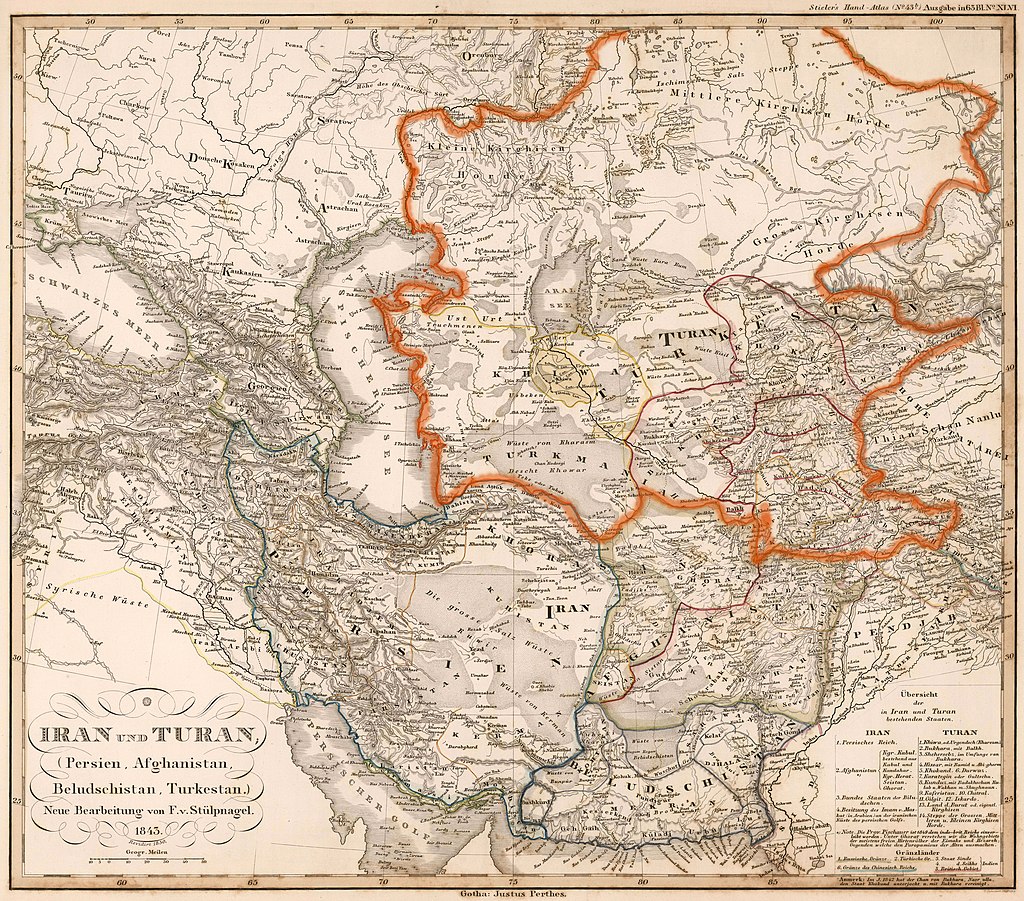
    But where was the Tugai, exactly? This is not something one can point to on a map, barring in the narrow case of the aforementioned nature preserve in China. Consider this excerpt from an 1850 revision of an 1843 map — “Iran und Turan.”1

    undefined

    The map is beautifully drawn, with colored borders showing both sovereign territory and “areas of control.” In the case of Khiwa (Khiva), the immediate environs are shaded yellow, with a neighboring area surrounded by a dotted-yellow-line border, illustrating the broader domains of the Khanate of Khiva.

    The map uses several commonplace cartographic conventions. The geographer drew masses of closely clustered dots to show deserts, millipede-esque lines for mountain ranges, stacks of parallel lines for massifs and hills, and black lines of  varying thickness to show navigable and shallow rivers. The map includes vast blank areas, particularly in Iran and the vast steppelands from Kiev and Poltava in the West to the See Tenghiz/Bakaschnoor (Lake Balkhash) in the East. Occasionally wetlands are indicated, if large enough; such is the case for the swamps along the shores of the Caspian near Astrakhan and east of the Ural River north of Gurjew (Atyrau). Nowhere on the map, however, would one find the tugai.

    The tugai was invisible, despite the fact that it remained, at the time of the map’s creation, an unbroken line of habitats. It supported tiger populations—which is to say it supported large deer populations—throughout the extent of this map, with especially dense clusters along stretches of the Caspian coast, the shores of the Aral Sea, and the river-lands of the Amu Darya.

    Let us consider a more detailed map, from later in the nineteenth century. This excerpt from an 1872 atlas sends some mixed messages.

    This portion of the map focuses on the southern shores of the Aral Sea and the Amu Darya delta. Following nearly the same conventions seen in the previous map, the cartographer shows hills, cliffs, rivers, and swamp-lands throughout the historic range of the tugai. Perhaps the exotic nature of the tugai prevented foreign observers from adequately explaining what they had observed, which in turn prevented the cartographers from expanding their own graphical vocabulary to include this distinct landform.

    This continues more or less to the present – compare with this excerpt from a mid-20th-century map of the region, and attached legend.3 In the modern landscape, still before the desiccation of the Aral Sea, the coastal and river tugai are represented by a confusing collection of map symbols, representing marsh, sand, and salt marsh almost simultaneously.

    Adding another ecological symbol to map an area so far from the centers of power may have seemed unnecessary, then and now. The few visitors to the area in the nineteenth century generally saw the tugai only from a distance, i.e., from the decks of river-going ships or from the backs of horses or camels. Has so much changed? At least in the “bad old days,” the luckiest of the exploring officers engaged in the most dangerous of sporting outings – the tiger hunt.

    The Caspian tiger is extinct today.4 The Soviet Union made a minimal effort to preserve a small portion of habitat in arguably its least developed republic, opening the first Central Asian zapovednik (nature preserve) in the Tajik SSR in 1938, following a tiger attack. The last traces of the tiger population in Tajikistan appeared already in 1958, and the last wild Caspian tiger seen anywhere was shot in Turkey in 1970. Following preliminary studies, however, an international team of scientists is recommending re-populating the Tugai of Central Asia with Siberian (Amur) tigers.

    A century ago, the desert [that is now around the Aral Sea] was known as the Reed Kingdom – a marshy delta area where the Amu Darya widened as it approached the Aral Sea. Bird life and wild boars abounded, and there were enough Aral Sea tigers that, according to Russian records, between 1886 and 1891 about 200 people were eaten by them.

    Aral Sea: an environmental disaster to rival Chernobyl
    https://geographical.co.uk/science-environment/aral-sea-an-environmental-disaster-to-rival-chernobyl

    The feasibility study produced an astonishing map, showing the historical range of the tiger, and some of its tugai habitat.5 Moreover, the Amu Darya delta south of the vanished Aral Sea retains enough tugai to possibly support a new tiger population… but the suggested acreage had already been leased to the government of China for oil and gas exploration.

    The study concluded by suggesting that the Seven Rivers region of Kazakhstan provides a better economic and political climate for the reintroduction of tigers, an area which also has had unconfirmed sightings of the supposedly extinct Caspian tiger.

    In closing, this post may seem to offer fodder to those fighting in the trenches of modernism, Orientalism, and cultural studies. I would only add a few words of caution.  This critique of “silenced” subaltern cartographers is itself suspect, in my opinion. What is the aim of this writing if not for the advancement of science? Will an addition of a new graphical convention to cartography make any meaningful change in the understanding of east by west, or vice versa? The mapping of tugai is important and useful, but perhaps the study of the slow realization by post-Soviet scientists in recent decades of its very existence is even more useful.


    1 Available online from https://vambery.mtak.hu/en/03.htm The website honors the famous Hungarian traveler and Anglophile Ármin Vámbery (1832-1913) and was put together in recognition of the 100th anniversary of his death. It includes a wealth of valuable archival material, including pictures, maps, and manuscripts.
    3 1959 Composite map of Siberian USSR, David Rumsey Map Collection
    4 Cheryl Lyn Dybas. “The Once and Future Tiger: Central Asia’s “extinct” Caspian tiger and Russia’s Amur (Siberian) tiger have a past—and perhaps a future—in common.” BioScience 60, no. 11 (2010): 872-877.
    5 https://www.wwf.ru/resources/publ/book/eng/460 Pre-feasibility Study on the Possible Restoration of the Caspian Tiger in the Amu Darya Delta. Hartmut Jungius, Yuri Chikin, Oleg Tsaruk, Olga Pereladova. 2009.

  • What Old Maps Reveal

    (This blog post I wrote for the Central Eurasian Studies Society in July 2015 has now become an excellent lesson in the ephemeral nature of the Internet. When I wrote it almost ten years ago it was to celebrate the availabilty of a set of maps, digitized and available from a University in Sweden… and now all of these links are dead, the maps maybe? still available.

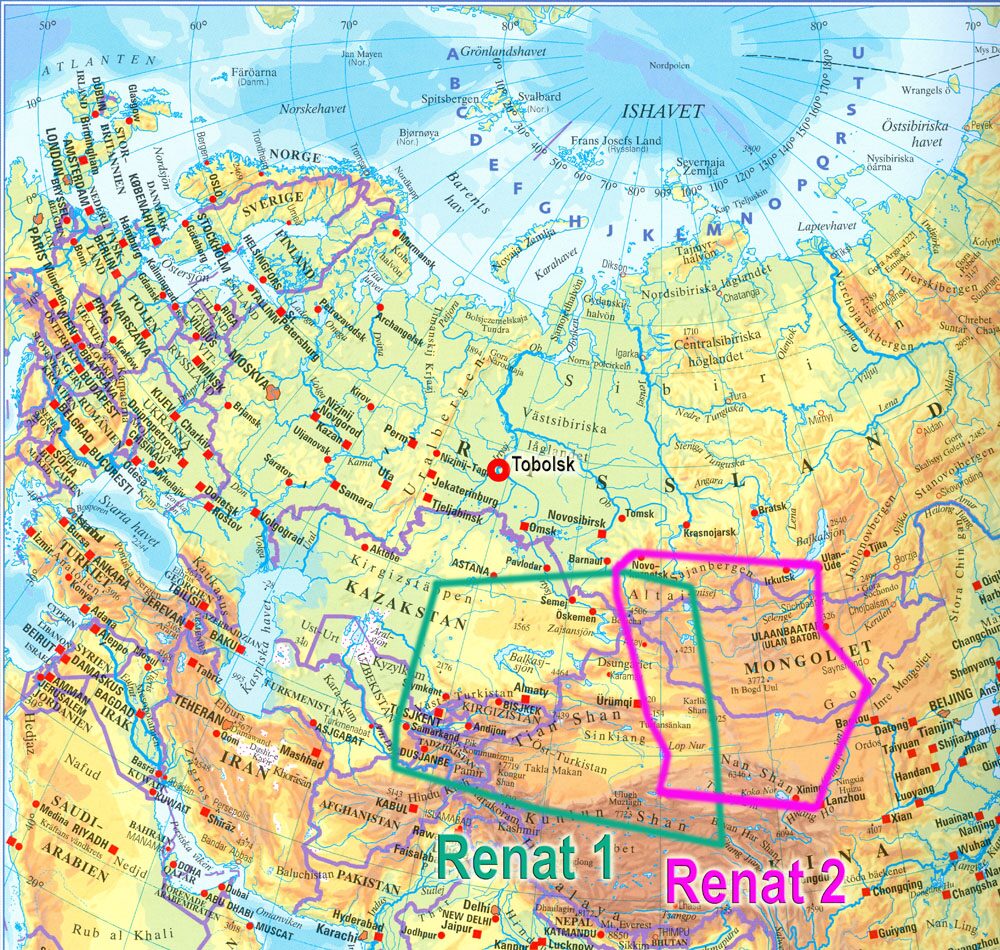
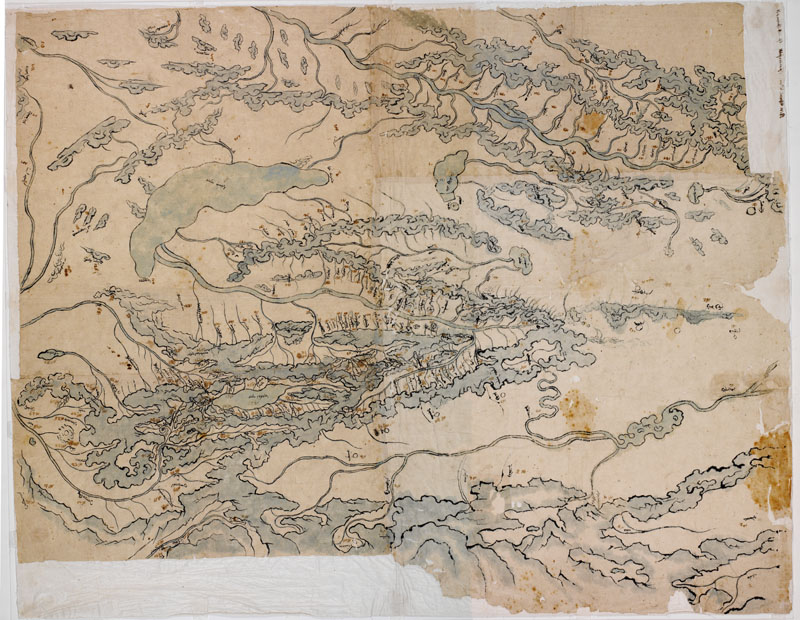
    The maps brought to Europe from Central Asia by Johan Gustaf Renat (1682-1744) in the early eighteenth century are little known outside a small circle of specialists.

    The two maps, together with sketches, copies, and translations provided by Renat and others are now available to the English-speaking public, following several centuries of being nigh unreachable. Housed in the library of the University of Uppsala since June of 2010, thanks to the efforts of Professor Emeritus Staffan Rosén, the maps have been digitized in very-high resolution and researchers around the world can zoom in as far as they would like when parsing the Oirat script. The maps include over seven hundred place names, a useful source for comparing the Oirat “clear script” with its parent Mongolian script and other neighboring writing systems.

    This next section assumes a linked image that no longer exists.

    For example, let us examine a small snipping of a map detail from the website, with a South-Up orientation. Both the original Oirat script and the Indexing of place names in Latin script are visible: № 24 – Tashkent, № 25 – Sayram, № 26 – Syr Darya, № 27- Yasi [Turkestan], № 30 – Arys River. The two parallel lines crossing from top center to lower right represent the Syr Darya, with tributaries flowing into the river. The curved lines along the bottom and left-hand margins represent the mountains, both the western Tien Shan east of Tashkent and the Karatau mountains north of Yasi. What I find interesting about this map is that mountains are not drawn as curved or pointed lines, but by lines which seem to represent a constant elevation threshold. In other words, inside the curved borders of a mountain shape, the land rises above some set limit, for example approximately 1500 meters above sea level.

    Renat’s maps have received some attention since their rediscovery in Uppsala in the late nineteenth century, mostly in Russian- and English-language studies of Central Asia. The most famous, perhaps, was the long treatment in John Baddeley’s 1919 colossal Russia, Mongolia, China, a two-volume analysis of maps and travel accounts which included valuable reproductions and overlays comparing maps with each other and with up-to-date 1919 maps. Göran Bäärnhielm of the Royal Library in Stockholm has synthesized most of the scholarship, briefly and in English, on his personal website (in English with clickable map scans) Bäärnhielm had offered one of the presentations when the Renat maps were moved to their current home in the Uppsala University Library back in 2010.

    For readers of the CESS Blog who, like me, are sadly illiterate in Swedish, the road to the maps’ online home is thankfully simple. First, navigate to the Image Search (Bildsök) page of institution’s website in Swedish. Here you may type any keyword, but in this case simply using Renat’s name may be simplest. So, type “Renat” in the search box and click the Search (Sök) button. This should bring up a page of results like the example image posted here, listing the original maps (Renat 1/A and 2/B), the various copies, and a few accompanying manuscripts (e.g. Renat’s key to his № labels).

    These maps are particularly useful in helping to illustrate the geographic and political landscape, as Renat’s copies included both commentary, ethnonyms, and approximate boundaries of the neighboring peoples in the region. There is much in this treasure trove that may interest the historian of “early modern” Central Asia; for example, the high degree of cartographic accuracy when compared with contemporary and even early nineteenth century European maps of the region allows one to wade into the debate of whether these maps represent an indigenous map tradition or an off-shoot of a Chinese cartographic school.

    In another example, one could productively compare Russian and Jungar mineral ambitions for the region in Renat’s maps, particularly with regard to Renat’s focus on placing rumored locations of gold mines. While Peter I sent two failed expeditions to the region in the early 1700s, historians do not typically view the invasions into Western Turkestan during the reigns of Galdan Boshugtu Khan (1644-1697, r. 1670-1694/97) and Tsewang Rabtan (1643–1727, r. 1694-1727) in a similar light. But from whom did Renat learn of goldmines in Tashkent if not from his Jungar captor, and the purported author of the maps, Tsewang Rabdan?

  • Elim ai: A Close Investigation of a National Melody

    Previously I wrote that I would use the blog for writing practice, more specifically for writing things outside the scope of my dissertation. Today I am making an exception: this is an attempt to write coherently about the subject of my next dissertation chapter. My next chapter is about the poem/song now commonly known by the title “Elim-ai,” a text closely connected with the story of the Bare Footed Flight.

    Before getting to the history of the Elim-ai song, let us observe just how close this relationship was in the last century.

    The Text and the Flight

    Let us begin with Mukhamedzhan Tynyshpaev’s 1927 article on the Bare Footed Flight. That article included the text of the song Elim-ai with a Russian translation. Tynyshpaev included the text (see below for his version) of the poem, which he introduced: “The historical disaster remains in folk memory with the following verses.”

    About fifteen years later, the poem again appeared connected with the Bare Footed Flight in the 1943 edition of the History of Kazakhstan edited by Anna Pankratova: “In the music of the 18th century, as in the literature of the same period, we see the song and melody “Qara taudyn basynan kösh keledi” (“Over the Karatau mountains come the nomads“) written about the event “Bare Footed Flight.” The music and words are full of bitterness and sorrow. They tell of the heavy oppression endured by the people.”

    Some twenty years later still, now outside the academy, one finds the poem/song alongside the Flight once again in Esenberlin’s trilogy Kochevniki/Köshpendiler (The Nomads). In the 1986 edition, the song appears on page 241, supposedly a nationwide response to the tragedies suffered by the Kazakhs.

    Presently, the connection is much more nationwide than Esenberlin imagined. Since 2004, every student hoping to attend university in the Republic of Kazakhstan must pass the so-called Unified National Test (ENT/ЕНТ in Russian, UBT/ҰБТ in Kazakh). The test is divided into several subjects, one of which is mandatory: the history of Kazakhstan. Thanks to this country-wide testing system, every citizen of Kazakhstan under the age of 30 knows by heart at least some details of the Bare Footed Flight. On that same test, one may have to produce the “fact” that Elim-ai was the name of a song produced by that catastrophe. Whatever the veracity of this connection, let us trace the origins of this “fact.”

    The history of the Elim-ai poem/song can be traced through history to the middle of the nineteenth century. Its content, form, meaning, and associations have changed as it passed through the hands of  ethnographers, “nationalist” historians, and later Soviet-trained scholars before being enshrined in the heart of  twenty-first-century “Kazakh identity.” Following independence in 1991, the song has indeed metamorphosed into a kind of trademark of Kazakh-ness. Now (in 2014) one can stay at any of a dozen Elim-ai hotels, send one’s children to a similar number of Elim-ai nursery or music schools, cheer on the Elim-ai soccer team, enjoy a meal at an Elim-ai restaurant or cafe, or even use the Elim-ai cell-phone plan from Aktiv.

    At least one reason for the popularity of the name is its meaning, though difficult to translate simply in English. Elim-ai in partial translation breaks down as “Oh, my El!” The final step of translation is the most difficult, since when one breaks open a dictionary, the word El denotes a state, a country, the homeland or fatherland, people or a people, the public, tribe, clan, a union, or more poetically an ally or friendly person.

    Understanding the word El does not become easier with progressive delving into its etymology.  The Encyclopedia of Islam states that El “has undergone a wide semantic development,” from its first known occurrences in the Orkhon inscriptions of the early eighth century, whose meaning V. Thomsen explained as “empire” or, more precisely, “a people, or union of people, organized under a kagan.” We also see El used in the title Ilek Khan, possibly coming from “El-lig,” or “holding an empire.” El appears in the eleventh-century Arabic-Turkic dictionary of Maḥmūd Kāshgharī with the definition al-wilāya, or “district, territory.” Kāshgharī’s definition coincides with its use in the Ottoman Empire in place-names like Rūm-eli (“Rumelia”), meaning “territory conquered by Rome.”

    So it is very difficult to conclude what, exactly, the title “Elim-ai” signifies. Soviet-era writers seem to have prematurely settled the issue, translating the song into Russian as Rodina moia, or My Motherland. However, Esenberlin’s Russian translator of Kochevniki/Köshpendiler offered the more poetic O, moi mnogostradal’nyi narod, (O, My Long-suffering People.)

    History of the Text

    To follow the history of this song, let us move in chronological order. The oldest identifiable text appeared in a collection published in 1885 in Orenburg, one of the administrative capitals of the Kazakh subjects of the Russian Empire. Petr Raspopov translated into Russian translation several Kazakh songs collected by Akhmet Zhantöreuly, an official within the Bukei Horde who graduated from the Officer School (Kadetskii Korpus) in Orenburg. Guessing the original Kazakh is made more difficult by the fact that Raspopov put the Russian translation into rhyming verse. Even so, as we will see, the text is clearly the progenitor of later versions:

    С горы Кара-Тау идут караваны:
    То, знать, перемена киргизской кочевки;
    Верблюдов грузить молодых еще рано:
    Нет клади на спинах, в носах нет веревки!
    Тяжка нам разлука с родными, с семьею,
    И жжет наши очи слеза за слезою.
    И как наме назвать это время? Ужасно,
    Что всякий лишь прошлое счастие знает!
    Погода к тому же буранна, ненастна,
    И пыль, и песок нам пути заметают.
    Для нас непогодье теперь будет хуже,
    Чем в зимнее время январская стужа.
    В какую ж живем мы тяжелую пору!
    Вернется ль когда к нам прошедшее счастье,
    Все семьи в разброд, и в детях опоры
    Родители больше не видят, к несчастью!
    Там мать, там отец без детей остаются,
    И слезы рекою все льются да льются!
    Увы, сколько бедствий послал ты нам, Боже,
    В гневе своем! И земля, что нам к ночи
    Постель заменяет, не мягкое ложе.
    Лежать ночью больно, идти днем нет мочи:
    Подошвы распухли, хоть в степи и гладко.
    Хотя бы плохую послал Бог лошадку!2

    Raspopov gives the title as “Karatau” (cf. Karatau Mountains) with a subtitle explaining the poem refers to migrations following bad/unproductive years.

    The next version of the song appears only in a 1911 book titled Түрiк, Қырғыз-қазақ һәм хандар шежiресi, which I mentioned in a previous post about Shakarim Qudaiberdiev.

    “Қаратаудың басынан көш келедi,
    Көшкен сайын бiр тайлақ бос келедi.
    Қарындастан айрылған қиын екен,
    Қара көзден мөлдiреп жас келедi.
    Мына заман қай заман, қысқан заман,
    Басымыздан бақ-дәулет ұшқан заман.
    Шұбырғанда iзiңнен шаң борайды,
    Қаңтардағы қар жауған қыстан жаман.
    Мына заман қай заман, бағы заман,
    Баяғыдай болар ма тағы заман.
    Қарындас пен қара орын қалғаннан соң,
    Көздiң жасын көл қылып ағызамын”.3

    This version matches the Russian translation so closely, there can be no doubt that it is the same text. This text is the oldest version available in Kazakh. Qudaiberdiev gives the song no title, explaining that those who suffered from the Bare Footed Flight sang a song they already knew: “…және жолда айтылған қазақтың ескi өлеңi мынау…” — “…and on their way, the ancient Kazakh song they sang was this…”

    Shakarim’s explanation makes it clear that the text predated the Bare Footed Flight, but the connection had been made. As we will see, the song’s adaptability to Kazakh catastrophes in the 20th century will illustrate the malleability of the song and its text.

    In 1914, a poem under the name “Elim-ai” appeared in issue 52 of the journal Qazaq, written by Mir Yaqub (Mirzhaqyb) Dulatov. The poem appeared again in 1915 in a poetry collection published in Orenburg under the title “Terme.” The text of the poem in no way resembles the others,3 which isn’t so surprising considering the vagueness of the title (Oh, My Homeland!). A thorough study of the topic demands an investigation of any text under the title “Elim-ai,” but it seems we may safely dismiss this text’s possibility of describing the Bare Footed Flight.

    The Text and the Music

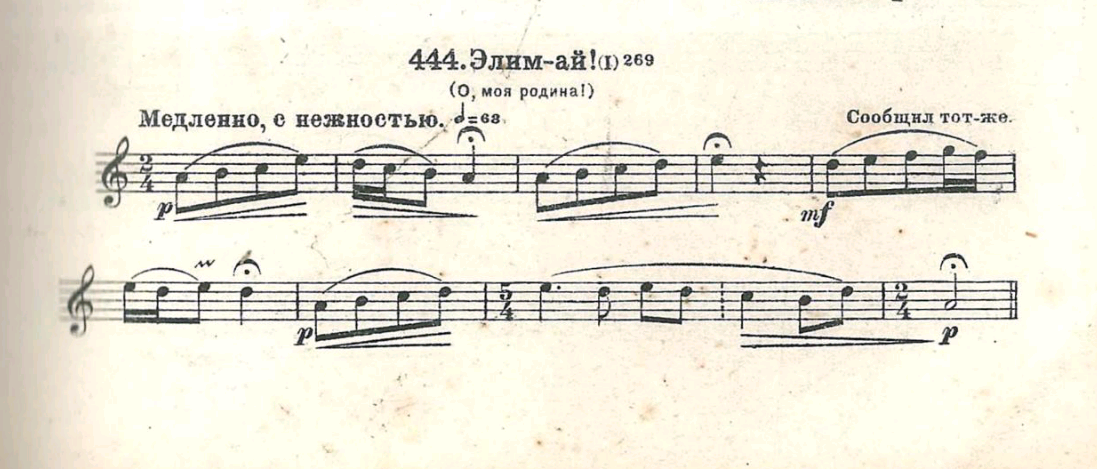
    The early Soviet era witnessed an era of renewed Russian interest in Kazakh culture, or more accurately, the problems of the lack thereof. Aleksandr Zataevich (1869-1936) was a European-oriented amateur composer from western Russia.4 A skilled pianist, Zataevich arrived in Orenburg in April of 1920 as part of a “concert brigade” and quickly found work teaching in a recently opened music school for the Muslim population. The Civil War was entering its final years and Orenburg soon became part of the autonomous Kirgiz (Kazakh) region of the RSFSR in October of the same year. Already in November, officials invited Zataevich to collect and publish traditional Kirgiz (Kazakh) folk songs, the results of which labor was a song collection in 1925, “1000 pesen kirgizskogo naroda” (1000 Songs of the Kirgiz (Kazakh) People). Without the aid of a recording device, musical ability with Kazakh instruments, or even a basic understanding of the Kazakh language, Zataevich collected fifteen hundred “songs” between 1920 and 1923. Particularly difficult to collect were the instrumental works played on the dombyra. Song no. 714 below showcases this excellently with an unrealistically simple and repetitive dombyra ostinato. Varvara Dernova, a Soviet musicologist who began her career with a deep analysis of Zataevich, criticized the composer-turned-ethnographer for actively “correcting” the folk music he collected with simplistic notation.

    In this case, I feel confident that my own undergraduate training in music composition at Western Michigan University in combination with my own experience listening to Kazakh folk music gives me the necessary credentials to suggest that Dernova was being too kind. His notations of folk-songs are simplistic and confusing. Too often he relied on erratic time-signatures to represent the prevalent poly-rhythms while simultaneously neglecting to represent any but the most basic embellishments of the melodic line. Vernova’s dissertation rose from a study of his original research notations, from which she concluded that once Zataevich decided to highlight the “whimsical” nature of Kazakh melody, he simply excluded the tunes which did not fit that general hypothesis.

    Zataevich and his work fall into the gaze of this project because he collected several songs titled “Elim-ai,” none with text attached, though each included a “vocal” line, one with dombyra accompaniment. Zataev included several pages of notes detailing the collection of the tunes and some interpretation of the un-included texts. In the case of Elim-ai, no connection is made with the Bare Footed Flight or more generally with the eighteenth century. Indeed, Zataevich explained that he collected No. 714 from a musician who explained its provenance as a tune sung by destitute Kazakhs forced to labor in the mines near Semipalatinsk in 1916.

    I have transcribed Zataevich’s “Elim-ai” tunes below:

    No. 444

    444

    No. 493

    493

    No. 714, with dombyra accompaniment

    714

    Not long after Zataevich published his encyclopedic magnum opus, Tynyshpaev presented his work on the Bare Footed Flight in a festscrift dedicated to V. V. Bartol’d, the orientalist then guest-lecturing in Tashkent. Tynyshpaev follows Qudaiberdiev exactly in his usage of the poem, explaining that the text relates to the Flight, but giving it neither name nor tune.

    As late as the 1920s, then, the song Elim-ai and the text connected to the Bare Footed Flight remained completely separate.

    In the early 1930s, the Kazakh polity had changed significantly. The Arabic script had been replaced by Latin, the borders had shifted drastically to exclude Orenburg, Omsk, and Tashkent while including Verny (Alma-Ata, today’s Almaty) and Ak Mechet (KyzylOrda, the capital of the Kazakh SSR until 1927). In 1933, the Union of Composers invited Evgenii Brusilovskii (1905-1982), a recent graduate of the Leningrad Conservatory, to move to the capital Alma-Ata and teach at the Kazak Music and Drama College.

    Here it is important to note the changing face of Bolshevism/Communism in the 1920s and 1930s. During the early days following the Civil War, it was impossible to predict which aspects of imperial culture were sufficiently revolutionary to remain while the bourgeois portions were liquidated. However, the “cultural” production under Stalin in the 1930s very quickly returned to the “safe” Russian Romanticism of again lionizing such icons as Pushkin, Tchaikovsky, and Glinka. In this way, instead of allowing some indigenous Kazakh artform to take center-stage, the Soviet leadership quickly explained that the lack of Kazakh operas, plays, and other European artforms was a problem with an easy solution: hire Russians to write them! The level of ignorance of Kazakh culture reached such heights that some suggested the Kazakhs had no form of musical culture prior the arrival of the Soviets in 1917!

    And so, not to put too fine a point on it, Brusilovskii, armed with Zataevich’s book of “authentic” Kazakh tunes, had all the resources necessary to write hundreds of Soviet-Realist operas. Brusilovskii admitted that he was willing to work in Alma-ata particularly because of his fondness for Zataevich’s book. Temirbek Zhurgenev, the Kazakh Commissar of Education, put the question directly: “Would it be possible for you to write an opera for us based on Kazakh folk music?” Perhaps Brusilovskii should have hesitated in his answer, because after replying in the affirmative, he was given thirty days to create the music for the opera which became the centerpiece of Kazakh national culture: Qyz zhibek. This process was undoubtedly made easier by Zataevich’s work, since Brusilovskii essentially harmonized already-existent tunes before delivering them to the librettist who then set the text.

    Naturally we can ask the question: were the tunes selected by Brusilovskii according to their connection with the Qyz zhibek story? And more naturally we may reply: of course not. Rather, Brusilovskii selected songs whose characteristics he felt construed the themes of the lead figures in the tale. First performed in November of 1934, the story was praised for its emphasis of the class struggle.

    Brusilovskii’s second opera Zhalbyr (1935) is the point to which this essay is racing, for in this work we have the actual origin of the song/text “Elim-ai,” though ironically without a connection to the Bare Footed Flight in the plot of the opera. The plot of the opera revolves around a group of rebels struggling under tsarist labor conscription in 1916, which suggests that Brusilovskii took the idea from the note Zataevich attached to Song No. 714. I have transcribed here an excerpt from the opera showcasing the leit-motif, the theme “Elim-ai.” Notice that, though the note to No. 714 inspired the opera’s plot, the composer clearly based the motif on No. 444.

    Click here to listen to the opera excerpt at NoteFlight, where you can also hear the other Elim-ai tunes.

    This dissertation chapter will also approach several other problems related to Elim-ai, including its supposed authorship by the legendary figure Khozhabergen, a statement made more precarious by its unequivocal stance on the poem’s title being “Elim-ai.” As we have seen, the text did not go with this specific title until the 1930s and its inclusion in the second Russian-composed Kazakh opera.


    1Translation:

    Over the Karatau come the nomads: The Kirgiz (Kazakhs) are changing camps; The camels are still too young to load: No baggage on their backs, no ropes in their noses! Grievous the separation from loved ones and family, And our eyes burn from tear after tear. What, then, should we call this time? It is terrible, That only past happiness is on everyone’s mind. Weather more inclement than blizzards, Dust and sand will blow us away. For us this weather is even worse Than the frost-covered fields of January. What awful times we live in! How will times of past happiness return, All the families scattered, alas the parents no longer see their children as support! There mothers, there fathers without children, And there a river of tears, weeping and weeping! Alas, so many disasters you sent, God, In your wrath! And the hard earth upon which We rest replaces our soft beds. Laying at night in pain, going in the day without strength: Our soles our swollen, though the steppe is smooth. If God could give us even a poor horse!

    2 Translation

     “Over the Karatau come the nomads. With them comes a lonely camel. It is hard to be parted from one’s family, tears dripping from dark eyes. What kind of time is this? A crushing time, a time when all happiness and wealth is lost. The traces of our flight throws up a cloud of dust, greater than a blizzard in winter time. What kind of time is? A time of chaos, a time of panic and destruction. Leaving behind one’s family and home causes a flood of tears to flow.”

    3 The untranslated text is below:

    Ем таба алмай дертиңе мен ертеден,
    Сол бiр қайғың өзегiмдi өртеген.
    Тырп етпейсiң бас көтерiп көрпеден,
    Енсең неге түстi мұнша, елiм-ай?

    Өткен сағым, келер алдың бiр мұнар,
    Қызылшылсың қызарғанға тым құмар.
    Сақтан деген сөздi жан жоқ шын ұғар.
    Жемге шапқан, қармақ құрса, елiм-ай!

    Қандай едiң, қара кейiн қайрылып.
    Қандай едiң, тұрсың одан айрылып.
    Мүгедек боп қос қанатың майрылып.
    Өксiп жаылап өгей ұлша, елiм-ай!

    Мұны құр бос өлең десең, өзiң бiл.
    Жұрт болмаймын өлем десең, өзiң бiл.
    Не болса да көнем десең, өзiң бiл.
    Босағада жүрген құлша, елiм-ай!

    Түзелесiң қашан, жұртым, оңалып?
    Тiл алмасаң, кетпеймiсiң жоғалып?
    Қайтер едiң өткен дәурен оралып,
    Жылы жүзбен мойнын бұрса, елiм-ай!?

    Сол күнiңдi көрсем — менiң арманым,
    Жоқтамас ем өзге тiлек қалғаным.
    Сұм жүрегiм селк етпейдi жалғанын,
    Бұл мiнезiң бойда тұрса, елiм-ай!

    4 Here I follow Michael Rouland’s 2005 dissertation on Zataevich and his role in the creation of the Kazakh nation and national identity. “Music and the Making of the Kazak Nation, 1920-1936.” PhD Dissertation, Georgetown University.

  • Johan Gustaf Renat

    Johan Gustaf Renat (1682-1744) was an amazing historical figure, a Swedish man with an uncanny skill for survival in strange environments who traveled further afield into Turko-Mongol territory than practically any other European in his generation. He has left an interesting trail of documents and traces in others’ accounts of the time, but still one must rely on conjecture and speculation to put together many of the personal details of his life.The image published with this post is a still from the 2005 Kazakhstan film “Nomad: The Warrior,” which includes a scene where Renat is demonstrating the firepower of cannons to the Jungar leader. Renat is present in two scenes in the movie. In both scenes, he makes the same sweeping motion with his sword, giving the order to fire cannons, first as a test, and later in a siege on a Kazakh city. This image makes for great cinema, but is ahistorical — there is no evidence any such artillery force under Renat fought against the Kazakhs.

    The son of Jewish immigrants to Sweden, Johan at the age of 17 joined the army of King Charles XII (r. 1697-1718), ruler and head of the Swedish Empire. Renat’s tenure in the military would see the ambitions of Charles XII dashed and the end to the regional domination by the Swedish crown. Charles XII was quite young at the time — in fact, he was the same age as Renat. His youth and military skill inspired many of the elites of the age, including Voltaire, who quoted him thus:

    I have resolved never to start an unjust war but never to end a legitimate one except by defeating my enemies

    Charles XII, King of Sweden

    The Great Northern War in which Renat fought under Charles XII came about largely because of the policies of Charles XI, the previous king of the Swedish Empire, particularly the so-called Great Reduction. In short, this angered many of the minor nobility who then worked to gather foreign powers that they might destroy the Swedish royal line and retake their lost lands and privileges. Renat would have been a member of an up-and-coming social class (the Christian-born son of Jewish converts to Christianity) with little in common with the nobility fighting Charles XII, so it is likely that his patriotism and support for the crown were born of legitimate affection.

    Between joining the military in 1699 and beginning his term as a prisoner-of-war in 1709, Renat reached the rank of warrant officer with numerous battles under his belt. In 1709, however, the Russian army under Peter I handed Charles XII his greatest defeat, at Poltava, dismantling the larger part of the Swedish military machine. Renat and his fellow officers were sent to Siberian towns for the duration of their sentence as prisoners-of-war until an official cessation of hostilities between Russia and Sweden. However, the education, experiences, and Western “charisma” stood the Swedish POWs in good stead seemingly wherever they went in the Russian Empire, as many of them lived comfortably in regional towns, some reaching respected positions of academic or civil authority.

    Renat’s activities, in general, are pretty much unknown. Rather, he shows up at certain events, like the defeat at Poltava in 1709. Several years later he emerges far to the east, on the Irtysh River heading south from Tobolsk, in 1716, in connection with the doomed expedition of Ivan Buchholz (1671-1741) sent by Peter I to find gold in present-day northwest China. It was on the Irtysh that Renat’s POW status changed hands, when the Jungars attacked and turned back the Buchholz expedition, returning to their capital with many prisoners, including Renat and his future wife, Brigitta Scherzenfeldt (1684-1736).

    During their stay with the Jungars, the Renats were treated fairly well. This stands in stark contrast to the horrors witnessed by both during the Great Northern War between Russia and Sweden and the climactic defeat of Buchholz’s forces. Scherzenfeldt later related to an English woman living in Russia the story of her near-rape during the Jungar raid on the Buchholz camp. That story, however, served her to explain the cultural chasm between themselves and the Jungars. The Jungar ruler questioned her personally why she had so violently resisted the sexual assault and, upon hearing that such things were not accepted practice in Brigitta’s homeland, ordered that no one attempt such violence again and gifted her to a woman in his court as a lady-servant. That same woman (either a daughter or a wife) was later implicated in the poisoning-death of the Jungar ruler, but Brigitta managed to avoid the retribution of the ruler’s successor.

    Renat's Cannons
    Renat’s cannons firing in “Nomad: The Warrior”

    Renat, during the same time, claimed later to have lived quite comfortably. Russian ambassadors arriving several years into Renat’s captivity found him living in a comfortable private home with enclosed garden and a position of respect, overseeing various workshops — including artillery manufacturing, a printing press, and weaving shops — in which his wife-to-be Brigitta worked.

    It was with the aid of a later Russian envoy that the Renat’s finally left the court of the Jungar ruler, taking with them an entourage of fellow servant-slaves and valuable gifts in return for their leal service to Jungar ambitions against Qing China. Among those gifts were two maps of incredible value and import — and I’ll discuss them in detail in a later post.

  • Antiquity and Tradition

    Traditions are crafted.

    Which is to say that they do not arise spontaneously out of the thin air, though the specifics of the tradition probably are generated spontaneously from the creativity of those acting out the tradition. In the case of a family, there is little like a tradition to give a sense of history and enduring continuity to a collective experience that so rarely feels permanent or stable.

    The most visible traditions are probably around holiday celebrations, if only because the family spends the most time together, away from other obligations. In other words, if your family “always” decorates the Christmas Tree on the 24th of December or “always” goes canoeing on Memorial Day, that is a strong statement of family identity with obligations extending into the future. Not only that, knowledge of these traditions and participation defines membership in the family. In deed, membership in a family is rarely binary, but rather a matter of degree or a sliding scale of involvement.

    In the case of history at the national level, similar traditions seem to serve similar purposes, being crafted similarly, with similar results. Children especially offer the point of comparison, since they are both the most obvious members of families (through knowledge and participation in family traditions) and of nations (through knowledge and participation in national holidays). Here I would make it clear that I mean school-children specifically. The school is, for many people, the first public institution where one encounters the agenda, whims, and plans of the state. In the case of the United States, the Pledge of Allegiance is a good example.

    I pledge allegiance to the Flag of the United States of America, and to the Republic for which it stands, one Nation under God, indivisible, with liberty and justice for all.

    Since its introduction in 1942, it has served many purposes, a common identity for US citizens not least of them. It has served to unify and unite disparate generations. When older citizens learn that a school has stopped reciting the pledge, the implication then is that a shared experience has been lost. The actual meaning of the words seems to be, if not secondary, than of less importance than many suspect.

    In Kazakhstan, I saw many celebrations of tradition. While they may not have been direct analogs for the Pledge of Allegiance in the USA, I believe they produce similar results. The least surprising were Soviet or Soviet-inspired, usually variations on the theme of “Memory Eternal” to the hero-martyrs and surviving veterans of the war with Germany, WWII. More interesting to me were the pageants and shows involving students in costumes portraying heroes of the steppe. The picture that goes along with this post comes from the “Last Bell” ceremony at my school in Sayram in Southern Kazakhstan — somewhat analogous with graduation day in the United States, though it includes performances by the entire student body, with speeches, music, and the showcasing of student activities, arts, and crafts.

  • Why are you doing this?

    “Why are you studying the history of the Kazakhs?”

    I heard this question many times and it deserves a better answer than I have given in the past.

    First, I would indicate that the question generally is no more specific than the above. In other words, there is no interest in why I’m studying the 18th century over the 20th century, for example. “Why are you studying the Jüün Ghar wars instead of wars with Russia or Kokand,” no one asks me. “Why all this focus on southern instead of northern Kazakhstan?”

    For some small portion of people, the question might be “Why does anyone study history at all?” I’m not particularly comfortable with my answers to this question. In brief, I study history because I want to and because, so far, I am able to do so. I want to study history because I love the stories, the explanations, and the way the stories and explanations change over time.

    For more people, I think the real question is “Why are you, Michael, studying the history of the Kazakhs.” What am I, and what am I not? I am not a Kazakh, first and foremost. I am also not a Russian or other non-Kazakh citizen of the Republic of Kazakhstan, the Russian Federation, or anywhere in the former Union of Soviet Socialist Republics. So, perhaps this question has various flavors: “Why is an American studying Kazakh history?” or “Why is a white, non-Russian studying Kazakh history?” or “Why is a Christian studying [Muslim] Kazakh history?”

    This is a problem in almost any field of history, or so it seems from my limited experience. A study of Indian History in the American academy who is not themselves Indian (or at least an Indian-American) will face similar questions and assumptions of ulterior motives. Similarly a non-indigenous person studying the history of Native Americans will likely face some serious questions as to just why, exactly, are they so interested in Native Americans? It seems that the majority of history is written by outsiders, in some light. At the end of the day, there are no diaries being published as “historical textbooks.” We are separated from the past and our subjects of study by time, if not also by religion, culture, language, and genetics. The measure of that distance may be great, but still we try to overcome through the strength of our arguments, evidence, and perseverance. How else can anyone write anything about the Ancient Greeks or the Han Dynasty in China? Despite what some nationalist policies have intoned, there is very little physically connecting those people to the current residents of our planet. In much the same, the inhabitants of the steppes of Kazakhstan in the 18th century have little in common with the inhabitants of the Republic of Kazakhstan, the Russian Federation, or the United States. The way of life alone separates the early Kazakhs from those studying them today, whether they work for a University in Kazakhstan, Russia, or the United States.

    One corollary of this assumption is the problem of explanation. When an insider writes the history, very many things get left unsaid, too much information and knowledge is assumed on the part of the reader. In addition, their is a common idea that distance creates clinical disinterest. No one may write without bias. Even the Zulu writing about the Sioux, while perhaps not directly biased in the Sioux’s direction, likely shows some preference to another population which faced near extermination at the hands of English-speaking, rifle-bearing invaders from Europe. In this way, I do not assume that because I am not Kazakh, I am the bearer of the sacred sight, free from tendentious favoritism.

    This compartmentalization in history seems to come from at least two sources, one of which I think we can resist. Many people are uninterested in “other people’s history.” One simple example is the programming of The History Channel, which even back in its heyday included very little information on peoples and places unknown to its viewers. While the shows may have included new and interesting information on the construction of the Egyptian pyramids or the military techniques of the samurai, the shows did not need to assume total ignorance on their audiences’ part. The History Channel, even then, was hoping to attract viewers — and reminding viewers that they know very little about parts of the world is not attractive. It seems we can find a similar pattern in the school and university curriculum. If knowing what you don’t know is a sign of intelligence, I can intelligently say I know very little about the history of Indonesia, the history of Somalia, the history of Patagonia, the history of Finland, the history of Namibia (notice the focus on the nation/state as the location of history).

    “Ah,” you say, “but the history of Finland is a waste of time for students in the United States. It isn’t important, it doesn’t explain anything, there’s only so much time in the schools.”

    I agree, to an extent. The point is that with our limited time in school and at university, many devote their time to a politically and culturally expedient study of history. We study Ancient Greece, perhaps, or Enlightenment France, or World War II, because those are “important,” which I take as a synonym for “helping to explain the way the world is.” However, I think we fail our students in this regard, as many things which might explain the world are left unexamined. There is a proclivity to “explain” why America and Europe are the great powers of the world — even when that is no longer the case. In other words, these stories will not help explain why America and Europe are slipping, why they no longer are (or soon will not be) the great powers of the world.

    Of course, history as taught in schools in most places in the world serves another goal: the creation of a patriotic and loyal citizenry. The nation and state gave birth to the schools. And the schools, today at least, are where history is born. The creation of professional historians in universities has little to do with the study of history in the schools, however, which is a topic for another post (or rather, another blog).

    I am studying the history of the Kazakhs, then, because anyone can study the history of the Kazakhs. I find them interesting because of my personal experiences in Kazakhstan, which came before my interest in the history of the Kazakhs. There are many positive aspects to studying their history which increase my appreciation for this occupation. However, I do not enjoy defending a non-Kazakh’s rights to the study of Kazakh history. If anything, I wish more non-Americans studied the history of the citizens of the United States.

  • Musings on Missiles

    This post is perhaps more rambling than some…

    I have several areas where my hobbies and my academic interests intersect. Since childhood I have loved strategy-based board games and other “war” games on the computer or other video game systems. I believe that that is what fuels my continued interest in military history.

    My love of Central Asian history and Turkology easily combines with this interest in several areas, including the military techniques and realities of both horse-archers among the steppe nomads and city defense by sedentary populations within Central Asia. These two groups often intersected, as horse archers would often raid other nomadic populations or the cities of the river valleys of Central Asia, while the city defense forces could also be mobilized to attack other cities. I assume, from my understanding of the limitations of early modern military technology, that the forces defending a city’s walls would have little success in marching against a nomadic force in the steppe.

    This becomes somewhat complicated by the advent of firearms, both artillery and light arms like muzzle-loading guns. Just in May of this year, I heard an intriguing paper from Professor Scott Levi from the Ohio State University at the CESS/ASEEES conference at Nazarbayev University on “Military Technology and the Early Modern Central Asian State.” The audience learned something of the intricacies surrounding firearm technology, like the move from matchlocks to flintlock guns.

    From Prof. Levi’s example, we can see there is still a great amount of research that remains to be done to increase our understanding of Central Asia during the era of the so-called Gunpowder Empires. This term usually applies to the 1300-1600s, the precise era which sees in Europe the replacement of archery and tension-based siege equipment (i.e., trebuchets) with gunpowder-propelled missiles.

    What I find on my mind these days is a diversion: how and why did the various military forces and other users of military technology come to abandon the lethal weapons and techniques associated with masses of horse archers for those weapons of the stationary infantry. Specifically, how did firearms and gunpowder replace spears, bows, and edged weapons? In the case of city-centered tactics, especially in densely populated areas of Europe that saw the evolution of warfare move from city- and castle-defense to battlefield-centric wars–in other words, why there are no cities in Europe maintaining walls.

    In terms of mastering the nomads, the masses of horse archers proved difficult to conquer. Even when outmatched in numbers or firepower, little prevented warriors from retreating deeper into the grasslands. Camps could be vulnerable, of course, though travelers accounts from the period give the opinion that few foreigners were able to travel in the steppe without the knowledge of outriders, scouts, shepherds, or other far-sighted steppe-dwellers. For those living in the open fields, the bow and arrow had several advantages — but were not without cost.

    The bow and arrow could be produced locally, given the presence of those with the skills necessary and the time to prepare the necessary materials. Susceptible to damage from humidity, the bows of the steppe did not travel well outside the continental climate of Eurasia–in areas of high humidity, like Mughal India, steel bows traded in power and flexibility for increased effectiveness in humid environments. However, despite their relative weakness in wet climates, in their home territory the bows offered devastating penetrating force in a deceptively small package. While the famous English Longbow or Japanese Yumi could penetrate armor with ease, its users could not fire it in motion, let alone on horseback. This is not to say that the English and Japanese did not ever mount archers — but by numbers and strategic importance, mounted archery did not dominate other military techniques.

    The superiority of the Eurasian bows came from its design, being both “recurve” and “reflex.” In the steppe, the experience of the Russian Empire in the 18th and 19th centuries seemed to prove that conquest was only achievable by taking control of the cities “supporting” the nomads of the interior. Perhaps more than archery itself, the lifestyle of the nomads protected them from the necessity of meeting the Russian forces in any battle not of their choosing. From what I have read, however, the Russians seemed convinced of their superiority in terms of military force and civilization. Still, many observers mentioned with respect the bravery and athletic ability of the “natives” of the steppe and mountains south of Moscow. From the “steppe” of the American prairie comes an intriguing example of the interplay between early muzzle-loading firearms and archery:

    [Viceroy Bernardo de] Galvez authorized [in his Instructions for Governing the Interior Provinces of New Spain] the sale of firearms to Indians, arguing that the use of guns would weaken Indians’ fighting ability, because the muzzle-loading rifle was less effective than the bow, which “is always ready to use.” [His Instructions] specified that guns should have “weak bolts without the best temper” and long barrels, which would “make them awkward for long rides on horseback, resulting in continuing damages and repeated need for mending or replacement.” This… would make the Natives dependent on the Spaniards for repairs and replacements. When Indians “begin to lose their skill in handling the bow,” he predicted, they would not only lose their military edge; to keep themselves continually supplied with guns, powder, and shot, “they would be forced to seek our friendship and aid.”1

    1 Pekka Hämäläinen, The Comanche Empire. Yale University Press, 2008: 131-132. The cited material comes from Galvez, Bernardo de. Instructions for Governing the Interior Provinces of New Spain 1786, translated and edited by Donald Worcester. Berkeley: Quivira Society, 1951: 48-49.

    Here I see two interesting points. The first is that archery and firearms could meaningfully coincide and compete with each other. The second is that the former was actually perceived by some Western observers as superior to the latter.

    I can also add that the tactics of the Spanish government representatives did not seem so effective, since “After… about 1800, most Comanches began to discard muskets and pistols and to rely on their older weapons.”2 The demise of the ability of Comanche’s to maintain their autonomy came now with the arrival of gunpowder, therefore, but much later — and the causes were more likely demographic and economic than force of arms. This is especially interesting when one considers that the Comanches apparently lacked anything similar to the reflex or recurve technologies for their bows. Perhaps this was because the bow was still a relatively recent invention, as up until 1500 years before the present, the peoples of the Americas used the atl-atl. If the peoples of the North American plains had had horses throughout the last 3000 years, one wonders if there would have been any bison remaining when the Europeans arrived — but that kind of “what-if” serves almost no purpose.


    2 T.R. Fehrenbach. Comanches, the history of a people. 1974: 125.

  • After the Fact

    First, a digression: several centuries ago, the English language was quite a different beast. I love to look through the entries at the online etymological dictionary for insights into the changing vocabulary of English as a means to getting at the change in thinking patterns over time. Many times it is the most mundane or boring words that have the most interesting entries. A good example is the entry for “the.”

    For the study of history in particular I find interesting the evolution of the words “event” and “accident,” which at one point were very close in meaning.

    Event (Latin – Eventus: ex- “out”  + venire “to come”)
    Accident (Latin – Accidens. accidere:  ad- “to” + cadere “fall”)

    Both could be used to refer to “something that happens,” but over time accident came to have the added meaning of “by chance.” Though rare, this older meaning does persist in some phrases, like “accident of history.” Of course, there are other meanings to consider: a car accident for one, and the philosophical accident (sometimes accidence) of Aristotle for another. In the Russian language, however, these three meanings do not belong to the same word and only the philosophical meaning is a cognate with English (Aкциденция, or Aktsidentsiia).

    The reason I find this interesting is how providence or chance manifested itself in the one word and not the other. Historical events have actors, planners, executives, members, participants — while historical accidents have participants, but not necessarily knowledgeable participants. To be fair, both historical events and accidents have victims. This difference in connotation I think is useful to discussing the measurement and judgment of historical actions and outcomes.

    I enjoy anecdotes about people in “historical situations” as much as anyone, when someone recalls being in or near a certain place at the specific time when a memorable “event” or “accident” occurred. However, I believe that most of these events are measured for their importance after the fact and the chance participants are later asked to account for the momentous nature of the occasion. There seem to be two outcomes in terms of anecdotes, the first I find most convincing:
    1) “No one knew at that time, but later we realized just what it meant…”
    2) “Of course no one knew at the time, but one could feel that something big was going on…” 

    This is my setup for a discussion of “after the fact” history.


    I paraphrase Chase Robinson when I write that a large part of understanding early Kazakh history requires coming to grips with how, as Kazakh identity emerged, oral traditions were complemented and, to some extent, replaced by written history. The transformation of story to history is conditioned not only by record keeping. Religious and national/ethnic attitudes play a role as well.

    Chase Robinson showcases this tendency by directly comparing early Islam with early Christianity. The early Christians were most concerned with Christ’s resurrection and its implications. The early Muslims were most concerned with Muḥammad’s career as God’s final messenger. Consider the difference in these simple statements: the wheres, whys, and who-said-whats of Christ’s prophetic career were (and are) of secondary importance to Christians, which is why any attempts to recreate the final years of Christ’s life (or any years of life) rely on conjecture and contradictory accounts. Belief in Muḥammad’s prophecy defined Muslims in start contrast to the other prophets that lived among the Hebrews, all of whom struggled with the disbelief and doubt of their constituents. The Muslims stand out as actually realizing a messenger of God walked among them during the lifespan of the prophet.

    However, Chase Robinson points out that both of these communities (early Christians and Muslims) very quickly ran into doubters and skeptics, whose arguments had to be addressed. “How do we know that theirs was God’s work?” The community of believers squabbled amongst themselves as they wrestled with these questions, the importance of which they knew to be secondary. But – the questions were answered, because they had to be, and “early Christians and early Muslims eventually came to tell the whole story.1

    What they could not remember they duly provided in the form of legends, myths, conjectures and reasonable guesses, all about things that they had no real memory of, since they had not really mattered before. This explains why Gospel accounts of Jesus’ birth, which were first set down about two generations after His death, are so much less reliable as history than accounts of his Passion; while Mark and Acts reflect earlier views and say nothing of Jesus’ birth, Matthew and Luke do, because these two later writers saw in it an opportunity to grind theological axes. This is also why Muslim historians began to fill in details of Muhammad’s pre-prophetic career, proposing a number of inconsistent solutions to a variety of academic questions. In what kind of caravan trade were the Quraysh involved on the eve of Islam? Where and when did these caravans travel? How old, exactly, was Muḥammad at the time of his father’s death?

    1 Chase F. Robinson, Islamic Historiography. Cambridge University Press, 2003, pp. 8-17

    I would only suggest one change to Robinson’s argument in this chapter. He writes, “for most Christian and Muslim historians, the purpose of history was generally not to test, probe or explain, nor to provide an accounting for all events that correspond precisely with what had once happened.” I would alter this ever so slightly be removing the qualifiers ‘Christian and Muslim,’ since it seems to me that “most historians” throughout history had other purposes for writing, including the modern era, the American academy of historians, and even the author of this blog. It’s difficult to articulate the ultimate causes for our actions, but suggesting that it is a love of objective history is confusing and not very convincing.

    In short, much of what makes studying the Bare Footed Flight for my dissertation exciting is placing two problems against each other. The first problem is finding and understanding contemporary early 18th-century sources describing the destruction of the Kazakhs at the hands of the Dzhungar/Junghar/Жоңғар. The second problem is following how these sources survive and change as the importance of those same events alters over time. In other words, the answer to the question “What did the events of the early 1720s mean?” changed many times in the following centuries — and the changes in that meaning offer a lot of useful information for the study of the region from 1700 to the present.