Author: mhancock

  • Thoughts on Love and Prayer

    I (Teresa) wanted to share a few reflections on love in our broken world. These reflections are very much based on religious beliefs, so you can decide if you’re interested in reading further. This past Monday (9/15) was the feast of Our Lady of Sorrows, and I dedicate these words to her.

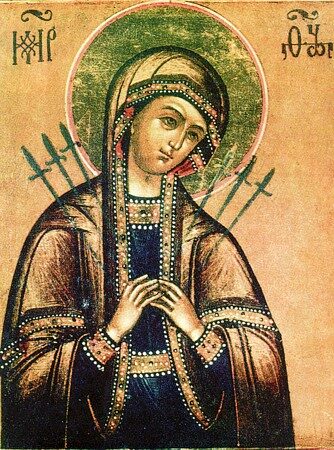
    Our Lady who softens evil hearts, Russian icon, 19th century

    We are called to love. Not a simplistic, cliché “all we need is love” love (no offense to the Beatles), but a challenging, authentic love that will transform us and allow us to bring God’s love into the world.

    To put this in no uncertain terms of our current political situation, I say with conviction: God loves Tyler Robinson. God loves Charlie Kirk. God loves Trump. God loves Biden and Harris. God loves x politician/social figure/difficult person in my life. Some of those statements are definitely easier for me to believe than others, yet we are all God’s beloved children, and God has created us all for good. Do we, can we, believe this? It breaks God’s heart to see us murdering our brothers and sisters, whether literally or figuratively with the slightest movement of our heart. God calls all of us to a more complete embodiment of love, even as He loves us and others in our brokenness and lack of love toward one another.

    Which people do I struggle to love?

    Whoever it is at any given moment, I have found it helpful to meditate on how deeply and fully God loves that person, setting aside from my thoughts any of their harmful beliefs/actions, for God loves us and others independent of our sinfulness (Rom 5:8). I ask to love them too, not in a self-righteous “look at me taking the high road” way, but in an authentic, humble way, with sorrow and repentance for my failure to love as God does. We were created in love and for love, for love of God and love of neighbor. God is love (1 Jn 4:8), and our union with Him, as well as our solidarity with one another, depends on the extent to which we enter into this love.

    I find that trying to love certain people with authentic, whole-hearted love, empty of self-righteousness, is very challenging. Yet, in my experience, this type of prayer gradually softens our hearts. It makes our hearts more like Jesus’s own Sacred Heart, as offered on the cross with an outpouring of forgiveness and mercy for all. We are called to be merciful, to bring good into the world (Lk 6:35-38; Col 3:8, 12-15; Rom 12:21). This prayer is an opportunity to offer to God those parts of our heart that are hardened against our brothers and sisters, those parts that struggle to love certain people—and we surely have good, legitimate reasons for this struggle. Yet, God calls us to more. Our world clearly needs more.

    This attitude, this way of being, doesn’t mean we stop advocating for the policies in which we believe or that we minimize the importance of social change, but it does help us, in our activism and all aspects of daily life, to relate to one another in a way that is truly loving, brotherly, and reflective of the society that we would like to build.

    Peace to you and to our world. Thank you for reading.

  • Maps Teaching History

    I love maps. I love writing about them. I love rescuing them. I love reading about them on the internet. I love to look at them hanging on walls. I love to touch them, to trace imagined journeys by fingertip — sliding a digit over the Alps to Innsbruck, along the high passes of the Pamirs searching for the Polos, along branches of tributaries of feeders of the Amazon. Maps can be extravagant works of art or a torture device when employed for quizzing geographical knowledge of my students. At some point, I decided that every class I teach will feature a map quiz about three weeks into a typical semester, graded generously but thoroughly. My map quizzes are simple enough, but perhaps unlike what my students have previously experienced or imagined.

    Searching for Social Studies Map Quiz produced this collection of “blank” political maps, showing political borders.

    The typical map quiz amounts to remembering coordinates on an atypical graph. The students are given a pre-drawn map, sometimes reproduced at a detail they could never recreate themselves — this reinforces the incorrect notion that maps have left the realm of the human for the rarefied air of computers and superhuman accuracy. Maps, like history for these students, is settled, figured out, finished–those who work with them are merely cataloging and describing. I might be completely wrong in my characterization, but it still inspired me to give a different kind of map quiz, with so far pleasing results.

    For my map quizzes, the semester begins with a study map provided to the students. Some ignore the study map entirely, naturally. But on the day of the map quiz, my students receive a blank piece of paper. Blank, clean, white, perfect and without blemish. No guiding hand, no prefabricated coastlines or political divisions. Upon that canvas they recreate a specific historical map, without borders, placing rivers, mountains, cities, and certain geographic features central to the topic of that particular class. I do not know if my students are acquiring anything something that can be measured in the dreaded genre of learning outcomes. That was not my goal, but I understand such an exercise could be quantified by others.

    Selection from one student’s finished map quiz in a Medieval World History class. I graded the quiz not on the accuracy of shoreline, but by my ability to read the map and their ability to place cities and geographic locations in the correct relative position.

    Do you also want to get deeper into maps… without closing your internet browser? I recommend starting an account at David Rumsey’s Map Collection. You might enjoy such sites as Adventures in Mapping or Strange Maps. But the best way to scratch that itch is to try your hand at map-making yourself, either on paper or digitally. The more time you spend with maps, the greater amount of their intrinsic value you can see.

    There are things about maps I dislike. As a scholar and a historian, specifically, I dislike that most maps have no scholarly apparatus, meaning that they rarely include a proverbial trail of breadcrumbs for me to follow the academic path taken by the map maker. Which books or accounts were used, which other maps were consulted, how did they come down on one side or the other of the many decisions made? Similarly, few maps include any awareness of the temporal nature of their existence. By this I mean that they usually do not announce what date they pretend to represent or, which is worse, they include a historic date to mark why certain areas have been highlighted without attempting to show how physical features may have changed. For example, most historical study maps of the Crusades or the Mongol Invasion or the Spanish Conquest or the Industrial Revolution simply use modern, up-to-date base maps for the image of the planet. Modern dams have radically changed the courses of rivers, creating and moving large bodies of water. Shorelines, deserts, forests, developed agricultural land; these are not timeless, eternal characteristics of the planet, but dynamic features. They have life-cycles and movement patterns that are both under-studied and under-represented, at least in this historian’s opinion.

  • Revisionist Hunnic History

    In the same vein as my previous post on New World Demographics, I would also like to share another controversial historical thesis. This is also the product of my teaching, but more recently from teaching two sections of Military History to 1789 and Introduction to European History, both of which cover (however briefly) the Hunnic Invasions of Ancient Rome, specifically the fifth century in Europe at the height of the Huns under Attila. Not to bury the lede: my hypothesis is that Attila the Hun’s most famous campaign (the sack and pillage of what-is-now France in 451 CE) was not the work of Huns, but more likely of Goths, Franks, or other Germanic tribes.

    The Sources

    Attila the Hun (1493 woodcut from Nuremberg Chronicle) as the literal Scourge (whip) of God

    I enjoy teaching history because I enjoy teaching my students that they have no control over what elements of the modern day world will remain in 500 or 1500 years to teach the future about our complicated lives. To be clear, even those works we consider histories were generally not written by authors imagining that their words would become the definitive story of their times. This is particularly true of our main sources for today’s discussion: Jordanes and Priscus. But I am getting ahead of myself.

    In this case, our classical understanding of history is sadly lacking in source material, leaving us with only a handful of authors to interrogate and understand as historians. Reflecting the near total historical ignorance of the day-to-day facts of this age, there are only educated guesses for the lifespans and biographies of these authors:

    1. Sozomen (Sozomenos, c. 400-450)
    2. Priscus (Priskos, c. 410s-after 472 CE)
    3. Jordanes (c. 500s – after 551 CE)
    4. Cassiodorus (c. 485 – c. 585)
    5. Procopius (c. 500 – c. 554)

    First, I should introduce the sources and explain their use to us in understanding Attila the Hun and his place in history.

    1. Beginning with Sozomen, his work is notable for the fact that his second volume of his Ecclesiastical History came out during the period of Hunnic tributes, treaties, and threatened invasions in the 440s. This work was dedicated to Theodosius II, the same emperor of Rome also oversaw the construction of the so-called Theodosian Walls of Constantinople between 412 and 414. The existence of his work alone is interesting evidence of the relative importance of the Huns and Goths, since they make no meaningful appearance in his history.
    2. Our nearly sole contemporary source on Attila comes from Priscus. The other sources that make some contemporary mention of the raids of Attila (into ancient Italy, not ancient France) appear in Prosper and Hydatius. Priscus, unlike his contemporaries, personally met Huns and in 448/449 took part in the embassy of the Emperor Theodosius to Attila and described a complicated individual prone to rage, but also to extreme tenderness with his children. Moreover, this embassy was quoted directly and thus corroborated in Jordanes (and presumably in Cassiodorus). Priscus reported finding Romans living peacefully among the Huns, married and happy to outside the corrupt and burdensome tax system of the empire. There he also met with the general and de facto ruler of the Western Empire, Flavius Aetius (391-454), whom Procopius called “the last of the Romans,” in a nod to similar compliments paid to Brutus and Valens by earlier historians.
    3. Jordanes is a horse of a completely different color, giving us both the most complete, and yet least reliable, version of the events of the 440s-450s, including the campaigns of the various Gothic tribes and Attila with his Huns. Jordanes was a propagandist for his emperor Justinian and generally wrote positively of the imperial system represented by strong emperors like Constantine, Theodosius, and Justinian. A key paradox of Jordanes’ work is the paradox between his endless appreciation and praise for the Goths alongside their constant revolts against the Empire during the course of their history. In the work, Jordanes stated his intention to explain the origins and histories of the Goths to explain the extremely complex geopolitical situation of the mid-500s. A central episode of this history is the period leading up to Attila’s invasion of Gaul in 451 at the head of a subject Ostrogoth army, forced to retreat by a Roman-Visigoth alliance.
    4. Jordanes, however, is a notoriously unreliable source on Attila, considering both his distance in time from the material and the fact that his history was actually a short abridgment of Cassiodorus. Nothing more of his Getica (History of the Goths) survives, but it should be noted that Cassiodorus had a connection with (and possible bias towards) the family of Aetius, Attila’s primary opponent in the text. In addition to Cassiodorus, there are brief mentions of the wars of Attila (again, centered on the Italian peninsula, not Gaul) in the surviving work of Procopius on the military and political exploits of his patron, the Emperor Justinian, The Book of the Wars. Procopius tends to be more well-known for its salacious counter-part, the Anecdota, or so-called Secret History, a collection of palace intrigues and sexual adventures (including the tale of the Empress’ private areas, a trained goose, and kernels of grain) that historians have long debated over.
    5. Finally, there are a wide variety of flavorful legends (like the Nibelungenleid), saints’ lives (hagiographies), and folklore which cannot be reliably dated within centuries of the events. In other words, they more likely represent the reputation that the Huns enjoyed in the Medieval period as the scourges of God.

    The Standard Story of Attila the Hun

    Cartoon appearing in the New Yorker, August 2nd, 1993 from Peter Steiner

    Jordanes, Procopius, and Priscus are generally combined to produce a coherent narrative, with caveats that their works are of uneven quality, uneven reliability, and uneven importance to the history of Attila and the Huns. Jordanes dedicates the most attention (of the surviving material) to the Huns, though Procopius takes pride of place as the official court historian of the era and the work of Priscus (such as survives) stands out as the only evidence of eye-witness testimony regarding Attila and his lifestyle. Jordanes, in epitomizing Cassiodorus, was satisfied by extremely high-level, big-picture narrative for much of his history of the Goths, but devoted singular attention and detail to the campaigns against Attila and the career of his chief Roman opponent, the consul and de facto ruler of the Western Empire, Aetius. Procopius, for his part, mentions Attila briefly in the third book of his multi-volume History of the Wars, specifically the first volume dedicated to the Roman wars with the Vandals (who sacked Rome within a decade of Attila’s own march into the Italian peninsula). Procopius explains that Attila’s invasion of Italy occurred as a result of the Roman execution of Aetius, contradicting Jordanes, who places Aetius in charge of the defense, specifically of the Hun siege of Aquileia. Procopius passes on the unlikely story that the Huns only took the city after a wall fell down of its own accord, which Attila predicted after seeing a stork abandon its nest in the wall the previous day.

    Briefly, here is the current rendition of Attila’s campaign into modern-day France as given in Wikipedia. It represents an eclectic blend of source material, including exceedingly unlikely legends and hagiographies of local saints credited with using divine aid to turn aside the Huns from this or that city.

    In 450, Attila proclaimed his intent to attack the Visigoth kingdom of Toulouse by making an alliance with Emperor Valentinian III. He had previously been on good terms with the Western Roman Empire and its influential general Flavius Aëtius. Aëtius had spent a brief exile among the Huns in 433, and the troops that Attila provided against the Goths and Bagaudae had helped earn him the largely honorary title of magister militum in the west. The gifts and diplomatic efforts of Geiseric, who opposed and feared the Visigoths, may also have influenced Attila’s plans.
    Attila interfered in a succession struggle after the death of a Frankish ruler. Attila supported the elder son, while Aëtius supported the younger. (The location and identity of these kings is not known and subject to conjecture.) Attila gathered his vassals and began his march west. In 451he arrived in Belgica with an army exaggerated by Jordanes to half a million strong. On April 7, he captured Metz. Other cities attacked can be determined by the hagiographies written to commemorate their bishops: Nicasius was slaughtered before the altar of his church in Rheims; Servatus is alleged to have saved Tongeren with his prayers, as Saint Genevieve is said to have saved Paris.
    Aëtius moved to oppose Attila [and his] combined armies reached Orléans ahead of Attila, thus checking and turning back the Hunnish advance. Aëtius gave chase and caught the Huns at a place usually assumed to be near Catalaunum. Attila decided to fight the Romans on plains where he could use his cavalry.
    The two armies clashed in the Battle of the Catalaunian Plains, the outcome of which is commonly considered to be a strategic victory for the Visigothic-Roman alliance. Theodoric was killed in the fighting, and Aëtius failed to press his advantage [against the retreating Attila].

    Interrogating the Sources

    Before we come to my argument, I will lay out the problems as understood by the consensus of historians. These are difficult to order, so I will be brief. Procopius gives no detail regarding the territory invaded by Attila, so that it might only refer to his campaigns in southeastern Europe in the 440s with “Scythians and Massagetae,” most likely meaning different tribes of pastoral nomads of the steppe. Aetius, according to Procopius, had earned the jealousy and mistrust of his peers by “conquering” Attila — where, when, or how is unclear. This leads to the execution of Aetius and the Hunnic invasion of the Italian peninsula and the annihilation of Aquileia after the unforeseen collapse of one of its walls… and that is all Procopius has to say about Attila.

    This woodcut portrait is from the 1575 Basle edition of Elogia virorum bellica virtute illustrium (Praise of Men Illustrious for Courage in War) by the Italian historian and biographer Paolo Giovio (1483-1552).

    Jordanes has the most to say about Attila, but how much of this comes from his summarizing Cassiodorus and how much from other sources (or his own imagination) no one can say. First appearing in chapter 34 of book two, Attila is described as the most famous man of the age and practically the single ruler of all the people of Scythia, which I understand to mean ‘all the nomads of the steppe.’ Jordanes than quotes from Priscus on the countryside leading to the encampment of Attila in modern Hungary and his palace within a wooden palisade. Leaving Priscus behind, Jordanes informs the reader of Attila’s intense, terrifying personality and characteristics and the fact that he “was born into the world to shake the nations.” Attila had taken this position through the finding and wielding of a sword sacred to all the Scythians and long believed lost.

    Attila, in the mind of Jordanes, longed to conquer “the greatest nations” of the time, apparently meaning Rome and, less convincingly, the Visigoths. He sought this through palace intrigues, letters, flattery, and threats to sow discord between the Romans and the Visigoths – but his efforts failed. Instead, he incited war between his own army and that of the Visigoths and Romans. Of note here are their ‘vassals:’ the Romans had on their side the Franks, Sarmatians, Burgundians, Saxons, and other assorted Celtic and Germanic nationes.

    Attila opposed this union and gave battle at the Catalaunian Plains, a flat space measuring more than 100 miles long… but Jordanes gives no details of any raiding or other looting of Roman Gaul. We are told that Attila arrived to Orleans because the Alan chieftain ruling agreed to surrender the city to Attila, but this was opposed by the Roman-Visigoth armies, who quickly raised a defense. Attila arrived, saw the earthworks, and asked his soothsayers the likely outcome of battle… it would go poorly for the Huns, but at least the enemy commander would die.

    Jordanes gives extreme detail to the battle following: a long afternoon and evening of hand-to-hand combat, swords and spears, with no mention of cavalry or archery. Jordanes tells us it was the single greatest battle in history, some 165,000 dead (CLXV milia), rivers of blood, and the King of the Visigoths died as foretold to Attila. The combat could have led to the total destruction of the Huns, according to Jordanes, but instead Aetius pulled back his Goths for fear that they would go on to overwhelm Rome once they had destroyed their chief foe.

    After the battle (when or from where is unclear in Jordanes), Attila moved his army “forward to attack the Romans,” but whom were they attacking in Orleans? Jordanes describes the invasion of northern Italy, the miraculous collapse of the wall of Aquileia, and the sacking of Milan and Pavia. The Hunnic commanders convinced Attila that Rome was a poison pill best left untouched and, while Attila was torn over whether or not to march on Rome, Pope Leo I emerged from the city to talk. He agreed to leave and return over the Danube, but that they should send Honoria, the sister of the Emperor, to him as a bride. And so Jordanes informs us that the entire Italian invasion was the fault of Honoria, who had sent secret messengers to Attila requesting his hand in marriage and the Western Empire as her dowry.

    My Argument

    My argument is predicated on some important and widely accepted assumptions. Namely, that the Huns of Attila were a branch of a much larger population of pastoral nomads across Eurasia, including the Hephthalites of Central Asia and the Xiongnu in northeast Asia. The archaeological record shows a pastoral nomadic culture with many unifying characteristics. Another assumption is that pastoral nomadism has traditionally been devalued, misunderstood, and demonized as savage, brutal, uncivilized, and indistinguishable from ancient hunter-gatherers. 

    I am not alone in my disbelief of the Hunnic invasion of Gaul. However, I feel as though I can speak intelligently as someone more familiar with pastoral nomadism, the history of the nomads of late antiquity (namely the “greater Hun family” of Huns, Hephthalites, and Xiongnu), and the historical trend to cast aspersions and doubts on nomads in defense of sedentary farmers and ‘honest’ forest-dwellers like the Franks, Burgundians, and (to some extant) Goths.

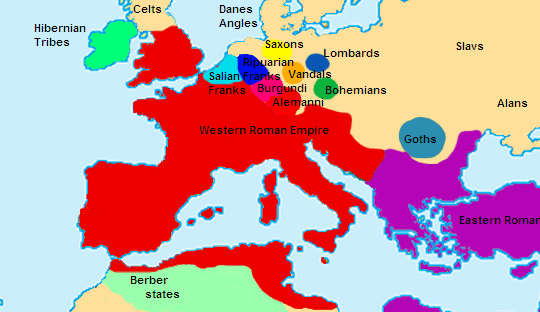
    Making maps to visualize geopolitical trends in history is fraught with difficulty, but they also offer an excellent, easy-to-grasp support for my argument. If we were to compare two maps of Europe, one showing roughly 400 CE and the other 500 CE, we would notice some interesting points.

    • Europe in 500 CE (Wikipedia map)
    • Europe in 400 CE (Wikipedia map)

    Modern-day France, an area previously part of the Roman Empire had, by 500 CE, become the domain of Franks and Burgundians, two Germanic tribes of the ancient world. Something, the reader will understand, occurred in the 400s. Migration, or Invasion, westward by the Franks and Burgundians, not the Huns.

    However, as we have seen, the standard story is different. The invasion of Gaul (modern-day France) that  history preserves is that of Attila, the Huns, and their Ostrogoth Allies against a combined Roman-Visigoth army. Jordanes, summarizing a now-lost work, lays out the history as one most important for what it reveals about Gothic intrigues. Attila offers a glorious speech, but the weight of the battle rests in its colossal loss of life, the heroism of Gothic valor, and the ultimate defense of the Empire thanks to Gothic sacrifice. However, if we compare the stories and critique the source material, we come away with a very different image. For example, if I compare one of the standard maps of the Hunnic invasion of Gaul with one reflecting only that information coming from (the weakest) of our historical sources, the difference is striking.

    Two maps: on the left, from Wikipedia, on the right, edited to show information from Jordanes

    Nothing about the military campaign of Attila in Gaul sounds plausible to me. Jordanes lavishes detail on the Battle of the Catalaunian Plains, devoting attention that he gives nowhere else in his summary. If the Huns made military actions similar to their other actions in the Eastern Empire (and fitting with our archaeological and anthropological understanding of the militaries of pastoral nomads), Jordanes would likely have remarked on the mass of cavalry, the reliance on horseback archers, and the general lack of spears, swords, and shields. Instead we read about a “typical” war between Germanic tribes, two gigantic blocks of heroes meeting in battle, swarming up and over hilltops, and a colossal (and reciprocal) loss of life. This version allows a great deal of flexibility to Goths like Jordanes and his Frankish and Burgundian readers; flexibility to blame the despoiling and desecration of the early Christian sites in Gaul on a foreign invader. Priscus, the fragment of whose work stands alone in reliability as a first-hand account, makes no mention of how the Huns fought their wars — but does mention gold-adorned weapons and horse tack like that found in the archaeological discoveries of the era. All of this is to say that the available evidence corroborates Priscus — but quite the opposite is true for Jordanes.

    Map of the Hunnic Invasions:  Note how the better-sourced invasions of the 440s and 452 seem plausible and logical for steppe-bound nomads in comparison to that of 451.

    I will close with the dismissal of this campaign by the “father of military history,” Hans Delbruck. He found laughable the numbers quoted by the sources (Jordanes suggested Attila had 500,000 men, whom Delbruck considered to be principally, if not entirely, Germanic tribesmen; Delbruck also noted Paul the Deacon‘s 8th century estimate that Attila’s army consisted of a ridiculous 700,000 Huns). He noted in one lecture that the wars of the 1800s, with the aid of railways and telegraphs, were unable to repeat Attila’s efforts in moving similar quantities of men and horseflesh from the middle Danube into central France. The modern science of logistics and military supply offered compelling evidence against the already unreliable source material for Delbruck, and I concur.

    Sources Cited

    Lighter Reading on Attila

  • Golden Age Piracy Reconsidered

    The crux of this post will be to introduce a new topic for this blog; the History of Pirates, Bandits, and Brigands. As a professor of world history, I have found success in teaching a survey course of such outsiders and supposedly unethical persons throughout history, from the Sea Peoples of the Late Bronze Age to the operatives of al-Qaeda and the Islamic State today. My particular fascination is with the so-called Early Modern period (ca. 1500 CE to the early 1800s), which means focusing on the piracy of the Mediterranean (Knights of Malta and Barbary Corsairs) and that of the Spanish Main before and during the so-called Golden Age of Piracy.

    Pirate, idealized: parrot, hook, peg-leg, eye-patch, bi-corner hat, cutlass, unkempt hair, buckles and boots…

    If one defines a pirate by their actions instead of their Golden-Age appearance, the potential group grows much larger. Pirates operate mostly by intimidation and hostage-taking for ransom, which allows historians to collectively compare the actions of early-twenty-first-century Somali fishermen and Niger river delta oil workers, eighteenth-century ex-Navy sailors in the Caribbean, early-twentieth-century Hong Kong fisherman, sixteenth-century corsairs sailing under the flag of Malta, and so on. (Note: the odd ones out from this group are the Buccaneers of the Caribbean dominant in the middle seventeenth century, though their name lived on to describe unrelated populations.)

    Yet for many, a pirate is easier to define by their looks than by their deeds. This is easy enough to explain: we’ve all seen people dressed as pirates, but few if any of us have seen people living the lifestyle of pirates. Pirates in the movies, for example, are quite successful at looking like what we expect pirates to look like… but fail spectacularly at behaving like the pirates described by their contemporary observers (whether in 1700s Caribbean or 1930s Hong Kong).

    To reiterate, the overwhelming of pirates throughout history did not look remotely like the pirates we see in the movies: parrots and peg-legs, eye-patches and bi-corner hats, flying a jolly roger and shouting, “Arrrr, matey!”

    The how and why of this specific dominant media type help illuminate general trends in our culture and the way we write history. To be quite explicit, I argue that:

    the Caribbean in the early 1700s became the Golden Age specifically because those pirates spoke English, looked like the majority population of the Caucasian West (USA, Europe, and her colonies), and threatened European colonial targets.

    Woodcut from Johnson, Charles (1724) A General History of the Pyrates

    Piracy as a way-of-life is both ephemeral and eternal. While few pirate populations have lasted more than a generation or two, it is a lifestyle that re-emerges fully formed each time it has been supposedly wiped out. Partly this is due to the illusion that state violence or legal action are effective means of ending piracy. Piracy is a lifestyle — when it no longer provides for its practitioners, it dies off quickly… only to pop up again when it offers an attractive alternative to the desperate and marginalized in society.

    One of the foremost historians of Golden Age piracy is Marcus Rediker, currently at the University of Pittsburgh and author of several books on the topic, including Villains of All Nations: Atlantic Pirates in the Golden Age. It is a book I know well from using to teach my History of Pirates, Bandits, and Brigands course in the past. He and other scholars have shown how the poorly-cared-for but highly-trained population of the European Navies emerged from the end of each in abject poverty with an attractive set of skills. It was this lack of compensation that might explain their easy transfer into lives of ocean-going brigandage. One modern analog would be the rise of computer hackers, often under-paid, under-appreciated teenagers and young adults with skills in a technology economy that continues to privilege seniority over ability. Another modern analogy would be the fishermen of Somalia pushed out of their traditional profession by foreign incursion into their coasts, yet with the boat-handling skills to turn to professional kidnapping-for-ransom.

  • Beyond Black & White, Part II: Language as Means to Effective Solidarity

    (By Teresa)

    I hope that this addendum will clarify and expand the ideas I presented in my previous blogpost.  My essential thesis in the former post was we are not born knowing racial categories–these have been dictated to us by historical circumstance and cultural convention–and so we can challenge these categorizations, especially with regards to how we, as individuals, see other people.  Yet, how can this shift play out in the context of individual identity, as well as wider society in which race (as we have defined it) continues to have serious consequences? 

    We are all people.  For me, this affirmation means that everyone possesses inherent dignity and value, irrespective of any other characteristics, whether chosen personally or imposed by others.  Unfortunately, in daily life we lose sight of our common bonds and we often view others as mere shells, rather than fully human beings who, like us, hold dreams and fears, joys and worries.  It takes energy and time to detach momentarily from our own plans and concerns–our own self– and instead consider everyone around us as a unique person of unknowable depth.

    Because we forget, overlook, or purposefully ignore others’ humanity, we contribute to pain, injustice, and discrimination.  This fundamental blindness to one another underlays society’s problems.  Although curing this blindness is almost certainly a utopian impossibility,  I firmly believe that we can train ourselves to consciously recognize others as people, and not just moving points that traverse our daily life (an idea further developed in my post Social Change, not Dehumanization.)   I suggested, in “Beyond Black and White,” that we avoid defining others through race-related adjectives, which reduce those we see to a racial identity with which they may or may not themselves identify.  If we instead think “person,” “human,” “friend,” or “brother/sister,”  we mentally affirm an essential affinity between us and others, even if the other is a stranger on the street.

    “Wait!” you say. “Won’t pretending race doesn’t exist just allow people with lighter skin to remain in willful ignorance about our country’s historical and ongoing mistreatment of groups of people with darker skin?”

    I acknowledge the concern, and I will get to structural injustices below.  However, my message is not to simply pretend race doesn’t exist, but to remind us that it exists only to the extent that we have allowed society to define it. Our DNA may determine our skin tone, but the association of skin color with a particular “race” is a social convention that our culture has created.  Therefore, little by little, we can undermine these arbitrary separations that lead to prejudice and discrimination.  We do not have to accept oppressive discursive structures that lead us to divide ourselves into disparate groups through language.  Racial terms, such as “black” and “white,” as we employ them today, are neither self-evident nor genetically determined; rather they are themselves a product of our country’s history of slavery, segregation, and on-going marginalization.

    “Wait!” you may protest again.  “If no one is supposed to identify as ‘black’ (or other races), aren’t you just enacting another form of oppression by denying marginalized groups ownership of their culture?”

    This is a more difficult objection, for I neither have nor want the authority to dictate how anyone sees him/herself.  But maintaining a critical eye when we view the terms we use to define society will not erase people, or their cultures, if we truly seek inclusion and solidarity.  We should continue to celebrate cultural heritages, as well as the varieties of cultural expression in our country today.  Anyone who feels that a racial term (“black,” “white,” or otherwise) strongly defines their experience should continue to self-identify as such; this is their decision.  I do hope, if our society grows more equitable and we see one another as family, that racial terms will slowly become more neutral and eventually fade away, but such a transition will take time and can only occur in conjunction with authentic gains toward equality.

    My immediate concern, however, arises when we begin to define others.  How can we see one another more as people, and less as categories, racial or otherwise?  Is mentally thinking “brother/sister” or “friend” when we see others a simplistic measure with no concrete results, mere wishful thinking?

    Identifying one another as a friend or brother/sister is much more than a naïve fantasy because the words we use, either in our own heads or when communicating with others, shape how we view the world.  Consider the choice of words to refer to those who are in our country without the proper documentation: are they “illegals,” “undocumented  immigrants,” “dreamers,” perhaps even “refugees”? Each term emphasizes a different characteristic with the purpose of rousing a particular attitude toward those in question.  This attitude, though itself intangible, will translate to subsequent support for or opposition to concrete policies that directly affect people.  People.  In the end, these people in our country are, most fundamentally, people–people like us.  Whether we try to solve immigration or another controversial issue, remembering that all involved are people (our human family!) can help us find common ground.  Such an approach leads to real, useful change that affirms the dignity of all, and especially the dignity of the most marginalized.

    Psychological research has demonstrated that our brains automatically register and respond to different physical characteristics, particularly those associated with race; as a result we may unwittingly display a negative or prejudiced reaction to certain people without even being aware that we are doing so.  Conversely, if we train our brains to immediately recognize those we see as friends, we can counteract destructive social messages that we may have inadvertently absorbed.  After all, will anyone discriminate against me or you if they view us as sisters and brothers?  Simply smiling can overcome implicit race-related biases.  At the individual level, therefore, changing our language can be very powerful.  As psychologist David Amodio notes, ” We might be able to reduce automatic prejudice just by convincing people that they are all on the same team” (51).

    Naïve colorblindness?  Not at all.  Rather, we cultivate an active and conscientious inclusive attitude toward one another.

    For anyone who is skeptical, I challenge you to spend a week purposefully viewing everyone you see with goodwill and openness, as beloved family members, with no other preconceived notions.  I am confident that you will gain an increased sense of interconnection and solidarity with one another.  This sense of solidarity forms an indispensable foundation for actions toward equality.  That is, we cultivate an inclusive attitude through our words and simultaneously ensure that our actions follow suit.  After training your mind to identify everyone as a “friend,” take Harvard’s implicit bias tests and see how you perform; our linguistic worldview will affect how we treat one another.

    Of course, we cannot stand outside of society, nor change conventional language through sheer will-power or good intentions. Race (as we have defined it) has very real, concrete consequences for many people on a daily basis.  These people may not have the luxury of deciding whether or not to consider themselves “black” (or other racial categories) because society labels and treats them as such regardless.

    Our response to racism and social inequality necessarily includes ongoing, concerted efforts to correct structural problems, such as the justice system and poverty.  My hope is that anyone reading this is also involved in programs and movements that aim to achieve concrete results and make visible gains toward equality.  Changing our language must complement, not substitute or replace, this essential activism.  Yet perhaps, I would suggest, these structural problems cannot be fully remedied until we stop inadvertently perpetuating categories that separate “us” and “them.”

    We will continue to contend with racial categorizations as long as our society groups us racially and disproportionately marginalizes members of particular races.  Yet, we as individuals form our society, and we can slowly transform it.  Take for example Daryl Davis, who has befriended hundreds of people in the KKK, many of whom subsequently left the organization.  (A documentary about him–trailer here–is available on Netflix.)

    I can imagine that someday, in the future, we will not accept racial categories as self-evident, but as the social and historical constructs they are.  To reach this point, we have to begin somewhere; our language is a necessary point of departure.  Our speech is action, and we can shape the way we think about and act toward one another through our own words, as well as the media we choose to consume.

    We all share a common humanity, and I firmly believe that this shared identity is greater than the differences we have created and perpetuated in our societies. Intentionally perceiving and portraying one another as human beings, rather than data points of a racial (or other) category, is one of many necessary steps if we hope to create just and equitable systems.

    Works Cited

    Amodio, David. “The Egalitarian Brain.” Are We Born Racist? New Insights from Neuroscience and Positive Psychology. Ed. Jan Marsh et. al. Boston: Beacon Press, 2010.  45-52.

    The cover image is the Hands in Solidarity, Hands of Freedom mural in Chicago.

  • Beyond Black & White

    A few musings that I probably do not have the authority to make… and yet, perhaps I can offer a minuscule contribution to a collaborative, inclusive worldview.  

    (By Teresa)

    My five-year-old daughter does not know what “black” or “white” means. At least, not with respect to race. When describing a new friend at school, Jansamal sometimes says, “She has brown hair, blue eyes, and skin like mine.” Or, “She has brown hair and dark skin.”  She perceives skin color, but for her it is just one of many physical characteristics.

    A year ago, after our third daughter was born, Jansamal (then four years old) commented, “I think Aqmaral is going to be brown.”  We had been discussing that in two years, Aqmaral (the baby), would be like Quralai (our then-two-year-old); Quralai would be like Jansamal, and Jansamal would be six.  To Jansamal’s interjection, we responded, “Brown?  You mean have brown hair?” “No, brown, you know, like Amari and Aaron.”  Amari and Aaron were two of Jansamal’s neighborhood friends.  “Oh,” we said, “Well, why do you have red hair and blue eyes?” Jansamal knows that her hair is the same color as her daddy’s, and her eyes are the same color as mine.  We reasoned, “You have hair and eyes like ours, and so does Aqmaral.  She will probably have skin similar to ours too.”  Jansamal accepted our explanation, but she has remained ignorant of race as a taxonomical concept.

    Some will note that our daughter’s innocence is only possible due to white privilege.  After all, she has not heard racial epithets directed at her, nor has she been treated negatively as a result of her skin color.  The term “white privilege” is problematic, however; it implies that to approximate equality, we must strip privileges from certain groups, rather than restoring basic rights to the under-privileged.   Characteristics often cited as “white privilege”—being able to assume that law enforcement is on one’s side; regularly seeing oneself reflected in media icons and popular culture; and going about one’s life without wondering if negative interactions are a result of one’s race—should be common expectations for all, and not privileges for anyone.

    Terms like “black” and “white” shift meanings over time, and we do not need to keep invoking race as if it indicated a fundamental difference between people.  I am reminded of the Lorax’s “unless” (when you’re a parent, all your literary allusions begin to come from children’s books): we will continue to view the world, and our country, as a conglomerate of various races unless…  we stop.  Unless we change our current discourse.  Unless we realize that, even though our brains will automatically note physical differences between people, we do not have to associate these characteristics with discrete categories.  Unless, in our minds we identify others not through the lens of race-related adjectives, but with inclusive terms such as “human”, “person,” or even “brother/sister.”

    (I have written more extensively on this idea in my previous post “Social Change, not Dehumanization: Using Language and Emotion Productively in Our Conflicted World.”)

    On an individual level, this shift is achievable with sufficient practice and intentionality. On a societal scale, race is not so easy to overcome; our racial construction of the world is tied to cultural identities, continuing inequalities, and past oppressions.  I am not suggesting that we cease to celebrate our ties to particular heritages, nor that we overlook correlations between social injustice and racial groups as we have defined them in the twentieth century.  Nevertheless, I believe that we can purposefully cultivate an inclusive sense of community as we strive to create a more equitable world.  If we deliberately choose to share and consume constructive media that affirms the dignity of all, we can slowly rise above the divisions we have created.  We will undoubtedly continue to disagree on certain points of policy, but we can promote discourse that recognizes each human being’s inherent worth.

    At some point in the near future, my daughter will be handed the fruit of racial knowledge, and she will eat of it.  Her peers, her teachers, and society as a whole will inform her that she is naked, and that her nakedness is white.  Unless… perhaps for her children, if we start now, we can create a society in which we no longer interpret arbitrary characteristics as definitive indicators that separate us.  We can recognize as illusory the “clearly”-delineated groups to which we thought we belonged, and instead see one another first and foremost as fellow human beings.

  • Reflections on Mercy

    By Teresa

    On November 20, 2016, Catholics celebrated the close of the recent Jubilee Year of Mercy.  Based on the Jewish tradition of jubilee years in which debts were forgiven, prisoners freed, and fields left fallow (see Leviticus 25), this past year has sought to make manifest God’s love and mercy in our suffering world.  As Pope Francis declared, “The Church… is called to offer more evident signs of God’s presence and closeness… [This year] is the favorable time to heal wounds, a time not to be weary of meeting all those who are waiting to see and to touch with their hands the signs of the closeness of God, a time to offer everyone, everyone, the way of forgiveness and reconciliation.”

    In the United States, this year has concluded with the Cubs’ win in the World Series—an act of mercy, perhaps, for all but Cleveland fans—followed by Donald Trump’s win in the presidential election.  This divisive latter event, an antithesis of mercy in the eyes of many, has deeply shaken my sense of community.  I reserve the rest of my thoughts about the election and the president-elect for an addendum below, as my purpose here is to discuss mercy, not politics.  Suffice it to say, with the breaches between us laid bare in a way I have not perceived during previous political disagreements, I have felt tempted to withdraw, to retreat from the mirage of human solidarity.  Yet, mercy impels us to reach out to others and to allow others to reach out to us.

    What is mercy?  First, there is the mercy that God shows humanity through Jesus’ sacrifice and death; this mercy continues to enter and shape our lives every day.  For those interested in Divine Mercy, I highly recommend 33 Days to Merciful Love and Daily Reflections on Divine Mercy.  These works, based respectively on the writings of St. Therese of the Little Flower and St. Faustina, offer daily reflections on how God reaches out to us in daily life.  But here I would like to discuss the mercy that we, as humans, show one another (and ourselves).  Human mercy is connected to, but not dependent on, belief in a divine being.

    Traditionally, merciful actions have been categorized as a series of corporal and spiritual works.  The seven corporal works of mercy are: feeding the hungry, giving drink to the thirsty, clothing the naked, sheltering the homeless, visiting the sick, ransoming the captive, and burying the dead.  The seven spiritual works are: instructing the ignorant, counseling the doubtful, admonishing sinners, bearing wrongs patiently, forgiving offenses, comforting the sorrowful, and praying for the living and the dead.  We can loosely place most merciful acts within these categories, but the concrete actions of mercy take many different forms because mercy is a mindset, not a to-do list.

    In this context, mercy is perhaps best defined as a kindness toward another, without expecting anything in return.  In essence, mercy is love.  Mercy is also responding to others’ love toward us, even when we are tired, annoyed, or hurting.

    In all of its manifestations, mercy directs our desires toward others.  Rather than prioritizing ourselves, our pride, or our own interests, we instead share, serve, and humbly receive what others offer us.  Most of all, we strive to see others in themselves, and not just in how they relate to us.  Psychologists have demonstrated that we tend to discriminate against outsiders while favoring those whom we perceive as being in the same group with us.  Mercy brings all humanity into this close group of friends and allies.

    Mercy also encourages us to think in terms of abundance, rather than scarcity.  When my brother and I walked the Camino de Santiago, a medieval pilgrimage route across northern Spain, I felt friendly toward the other pilgrims, but also anxious.  It was June, and the popular pilgrimage attracted enough walkers that pilgrim hostels could fill up; we might have to walk further than planned, or miss out on staying at particularly unique hostels housed in old church belfries or Romanesque chapels.  If other pilgrims passed us, I feared that they would take beds that we wanted.  These uncharitable feelings bothered me, yet I could not let go of my concerns.  Finally, toward the end of the pilgrimage, I resolved to greet each pilgrim as an individual fully loved by God, and for whom God had special plans.  All were my brothers and sisters, and I needed to genuinely treat them as such in my thoughts.  From that moment on, I didn’t worry about how many pilgrims might be ahead of us, or planning to stay where we wanted; I wished everyone well, and trusted that we would all end up where we needed to be.

    Of course, whole-hearted sharing and trust in abundance is not easy when, in practice, resources do seem very limited.  (I speak from the perspective of someone on the job market, in which I compete with hundreds of applicants for each tenure-track job.)  Our desires are not always realized, especially in the way we prefer. Yet I believe that if we genuinely orient our desires around others, not ourselves, ourselves, we will find that we have that which is sufficient.

    In this way, mercy heals the rifts between us.  We view others as our family, members of ‘our’ group.  Mercy will not necessarily reconcile differences, but it will build bridges over the chasms that separate us.

    Mercy also reveals our vulnerabilities.  The spiritual works of mercy in particular demonstrate our own weakness.  When we perform a corporal work of mercy—feeding the hungry, or visiting the imprisoned, for example—in most cases we ourselves are not literally in need of the same mercy.  We are in a position to be charitable toward others.  In contrast, most of the spiritual works of mercy (instructing the ignorant, counseling the doubtful, admonishing sinners, bearing wrongs patiently, forgiving offenses, comforting the sorrowful, and praying for others) remind us of our own need for mercy.  If we are honest with ourselves, when we bear wrongs patiently, forgive, and counsel, we realize that we are equally in need of these merciful acts from others.  We need comforting, admonishing, and instructing; we need prayers and forgiveness.

    Recognizing our imperfections before God may not be particularly difficult—it is not hard to accept second place when you are competing against an invincible opponent–but to admit our shortcomings before other imperfect humans, and receive their mercy, requires much more humility.  Receiving mercy also brings joy, however, once we realize we need it.

    How can we show mercy in the face of serious wrong-doing and injustice?  Mercy obliges us to recognize perpetrators as brothers and sisters whom we should love even as they are held accountable for their deeds.  We can imagine Adam and Eve’s consternation when they realized one son had killed the other, yet God spared the murderer’s life (see Genesis 4 for the story of Cain and Abel).  After the crucifixion, we can imagine Mary holding Jesus’s lifeless body, mourning his death, perhaps wrestling with the temptation to curse those who unjustly tortured and murdered her beloved son.  Yet she was asked to show mercy to his persecutors, in imitation of her Son who pleaded “forgive them” (Luke 23:34).   In our own time, the Amish famously forgave the man who shot ten children, killing five.  We, like Jesus and Mary, like the Amish, are compelled to let go of bitterness and anger.

    Mercy reminds us that in difficult situations, we exercise forgiveness and love as acts of obedience or will, independent of personal ‘feeling.’  “Forgiveness is an act of the will, and the will can function regardless of the temperature of the heart,” writes Corrie ten Boom, who forgave a prison guard from the concentration camp where she had been imprisoned. We can train ourselves, even when we don’t feel merciful, to act and think mercifully.  After all, from a religious perspective, God’s mercy pours over us all.  Recognizing that we are all in need, we should give and receive mercy liberally.  As we act more intentionally, we can internalize a merciful mindset.

    In a more present-day example, Immaculée Ilibagiza writes about forgiving those who killed her family during the Rwandan genocide.  When visiting a prison, she personally forgave the man responsible for her mother’s and brother’s deaths.  At a later date, Immaculée visited her former village and encountered one of her mother’s old friends, Mushaha, now shunned by the villagers because she and her husband contributed to some of the killing.  Old and sick, Mushaha mourned her own two children, who had died of cholera in the aftermath of the genocide.  To her also Immaculée showed mercy, rather than vengeance.

    Mercy does not erase nor deny the suffering and tragedy occurring in this world, but it mitigates the despair, anger, and sorrow that pursue us.  Mercy also encourages us to continue building up the world, regardless of the many events and actions that simultaneously pull it apart.  Our broken world is a brokenness we all share; mercy allows us to endure it together.

    It is important to note that mercy is not relativism, passivity, or fatalism.  Not everyone is equally right, and we must protest and use all the activism available to us to address unjust situations.  We can—and must—condemn the Rwandan genocide, for example.  But, as Immaculée has shown by example, we must avoid condemning our fellow human brothers and sisters; they may deserve punishment, but they undoubtedly need mercy.  In all situations, most of which are much more nuanced and debatable than the Rwandan genocide, we must remember first and foremost that we are dealing with people, individual human beings like ourselves.

    In the end, mercy is openness to others:  to trusting, to helping, to listening, to reconciling, and to opening ourselves to others’ mercy and forgiveness toward us.  Mercy is a continual reaching out, a continual willingness to start anew.

    Of course, I do not really attribute the Cubs’ triumph to divine mercy (unless my grandmother, who had a successful career as a secretary, slipped the World Series onto God’s to-do list), but their long-awaited success shows how an act of ‘mercy’ leads to shared joy and unity between people.  In the context of a sporting event, these feelings are fleeting and superficial, but in our own lives we can nurture genuine, abiding joy and unity in our relationships with others, even with strangers.  This past election and its political consequences are an opportunity for us, on all points of the political spectrum, to show and receive mercy.  And mercy leads us to look beyond differing opinions to instead embrace one another and rejoice in our common humanity.


    Addendum

    (For anyone who would like to know my thoughts on the election; these are the thoughts and feelings that led to my previous reflections on mercy):

    Why am I so shaken by this presidential election?  Not because Clinton lost, even though I did vote for her.  Not because I consider conservative policies to be inherently flawed—I might have voted Republican had they offered a candidate whom I could support.  My unease does not even stem primarily from Trump’s victory.  I can think of at least two scenarios by which I would not be particularly upset about the election (though perhaps still concerned about the next four years):  Trump wins a small portion of the vote (25-30%), with the rest divided equally between the other three candidates.  Or, most people choose not to vote, and Trump wins with extremely low voter turn-out.

    In both of these scenarios, as a country we are still rejecting the hateful overtones of Trump’s campaign.  We are not actively overlooking the veiled allusions to, or at least complicity with, armed uprising should the ‘rigged’ election not go his way.  We are standing against his blatant disregard for facts and evidence.  We are not endorsing for president a man who might base policy on fabricated information, a man who might endanger our democratic institutions, a man who might blame our country’s difficulties on religious or ethnic scapegoats.  In fact, however, nearly half of voters chose precisely this candidate.  As a result, I have found it difficult to take communion at church, participate in public events, and interact with others in the tasks of daily living, when I know that some of them must have voted for a person who seems to betray values that I thought most of us held dear, regardless of political preference.

    The sadness and anger that I have struggled to let go, therefore, come from knowing that many, many people implicitly sanctioned Trump’s campaign style and rhetoric by voting for him, even though they opposed such rhetoric and were motivated by other reasons.  In effect, as a nation, we declared that our motivation for voting—desire for a conservative Supreme Court / frustration with current politics / dislike of Clinton / gun rights / or x reason for supporting Trump—was more important than standing united against incendiary, hateful speech.  I am sympathetic only to voters who chose Trump because they are genuinely struggling to support their families.

    I cannot even be hopeful about prospects for the pro-life movement, a part of the Republican platform that I actively embrace.  I fear that any gains made against abortion will only inspire backlash, for legislative or judicial action alone will not counter our society’s tendency to see an unborn child first and foremost as part of a woman’s body, rather than as an individual human being.  Any measures limiting abortion must be accompanied by compassionate programs to assist women in difficult situations, as well as genuine recognition of unborn babies as human life worthy of protection.  A pro-life mindset is not so much about abortion itself; it is first and foremost about defending life—all life.

    All life, of course, includes people with whom I strongly disagree.  “I want justice, but I’ll settle for some mercy,” sings Kris Kristofferson in his song “Pilgrim’s Progress.”  I may still feel anxious and ill thinking about the election and what, in my mind, it represented, but I will continue to reach out to others.  May they continue to reach out to me, and may I be receptive to the mercy they offer.  In the end, hope does not come from policy or righteousness, but from our mercy toward one another.
  • Social Change, not Dehumanization

    By Teresa

    This post is a reflection on how we often inadvertently dehumanize others as we seek to portray our world through language, especially when discussing divisive issues.  Instead of contributing to this dehumanization, however, we can conscientiously use language and emotion as a recourse against violence.  Except in perhaps the most extreme situations (if at all), I do not believe that we can act or speak violently toward others whom we truly view as fully human, individuals of intrinsic value similar to ourselves.

    Language is important because it shapes who we are; the language we use slowly influences the person we are becoming.  Negative or aggressive language changes our personality over time.  Consider, for example, the man who impersonated a slave owner for a historical program called Follow the North Star at the Conner Prairie open-air museum in Indianapolis. The yelling and insults he utilized in that role began to undermine his previously gentle, caring demeanor, even when he was not at work.

    Continued exposure to, or use of, insulting and biased language leads us to view others as either allies or opponents, without seeing them as full human beings.  This type of engagement, of course, dehumanizes others and reduces them to a viewpoint or policy with which we either agree or disagree.  It seems we often bemoan how in the world today we frequently talk past one another, without listening in good faith to differing viewpoints.   I believe this lack of communication occurs because we focus on others as representing opinions, rather than as people.  When we effectively forget or ignore that we are dealing with other humans inherently equal to ourselves, we become most concerned with our own viewpoint triumphing.  Others “deserve” to be insulted because their worldview is in some way deficient.

    Considerate language, on the other hand, enables us to maintain a fundamental respect for others.  We can identify the underlying concerns that motivate different viewpoints and work together for acceptable solutions.  I am aware that in many cases, adequately addressing and reconciling all underlying concerns is impossible.  However, even in situations when we cannot morally accept another person’s belief or action, we can still value their intrinsic worth as a fellow human being.  We can see them first and foremost as a person.

    The dehumanizing effects of insulting language may seem obvious, but what about the other words we use to portray our world?  I would argue that categories we use to group people–nationality, race, creed, gender, political affiliation, economic status, profession, etc–are similarly dehumanizing because they reduce individual humans to particular characteristics that mark the group to which they belong.  I refer to the ‘group’ most immediately being referenced in any specific context; as people, of course, we occupy an infinite number of shifting affiliations.

    Categories, unlike insults, cannot just be avoided, for they are linguistic tools that allow us to make sense of our surroundings.  Indeed, categories can be useful means to research and map the world, and they allow us to identify–and hopefully remedy–disparate privileges and rights between groups.  At the individual level, our affiliation in certain groups may give us a sense of belonging and/or notably mark our identity.   Categories, therefore, are not necessarily negative, and we may choose to embrace group monikers as essential elements of ourselves.

    At the same time, categories dehumanize when we use them carelessly, passively, without actively remembering that no category fully encompasses the individuals of whom that category is composed. A corollary of this point is that we cannot assume we know something about an individual based only on our knowledge of their membership in a group. Most groups are so vast, with such diversity, that even baseline statements have occasional exceptions. Definitions, such as income designations, that we apply to mark off groups may be momentarily useful in particular contexts, but the information they convey is superficial and ephemeral.  We do not really know what any individual person believes, thinks, feels, or does solely because they, whether through self-identification or imposed definition, fall into any given category.

    So, how do we ensure that we don’t dehumanize others as we read about and describe our world?

    I suggest cultivating attitudes toward others founded on embracing our shared humanity. We can remind ourselves frequently that members of ‘x’ group are complex, individual people, whose views, actions, and histories may or may not align with those typically associated with the group. Even when we use categories, as we often must, we can be aware of their limitations; we must conscientiously negate their power to eclipse individuals. With these periodic mental checks, we acquire an underlying awareness of the human beings who populate our world, and we nurture our ability to recognize others as equally human. This attitude will ensure that our default mode of interaction is respectful and loving.

    Most of all, I think a humanistic perspective can best be achieved by actively wishing good on those with whom we disagree. This can be difficult, especially if we consider people whom we truly believe to be doing harm in the world, such as influential politicians whose policies we despise, perpetrators of violent crime, or the leaders and members of ISIS. However, we immediately humanize our opponents if we authentically desire their well-being. Everything we would like in our own lives–joy, peace, love, self-realization, meaningful relationships, generic “good things”–we can desire for others. Not in a self-congratulatory, condescending, patronizing, or conditioned way (“You are very wrong/blind/self-deluded, but because I am enlightened and a better person, I will still wish you well.  I hope you come to a better understanding of the issue”), but with genuine desire for the person’s well-being (“You are a human being, just like me, and you have your own convictions, aspirations, trials, and joys, just as I do.  I think your beliefs on ‘x’ are fundamentally flawed, and I will do what I can to promote my own ideas, which I believe to be better for society.  Regardless, even if you never agree with me, I sincerely hope life treats you well, and I wish you happiness”).

    This is not to wish for the success of policies, viewpoints, or actions that we oppose, but to desire another’s good at an inner, fundamental level.  This practice can also lead to humility as we remember that, for someone in the world, we also represent a person with detestable ideas or actions on whom it is nearly impossible to wish well-being.

    With an awareness of others’ inherent worth as human beings–which one might characterize as a true, unconditional love of neighbor–we can then strive for our actions and speech to correspond appropriately.  We might reflect on the messages we communicate as we speak, write, and share media.  We can choose carefully what we read, and how we portray others.  The more we expose ourselves to or utilize dehumanizing language, the more likely we are to act accordingly, perhaps even with violence toward those with whom we disagree.  The less likely we are to work together constructively to seek and implement actual solutions that improve society.   Conversely, if we view people as fellow human beings and not merely as members of an ‘other’ category, we can respond to conflict and disagreement with compassion.

    My argument may raise ethical concerns; members of under-privileged or oppressed groups have historically, perhaps personally, been denied the compassion, equality, and inherent humanity for which I am advocating. Am I asking them to extend these same attitudes and ideals to all, including those who have historically or individually perpetrated injustices? Ultimately, I am. I believe that the only true way to minimize injustice in the world is to embrace the idea that everyone, even one’s opponents, are equal human beings. Otherwise, we are perpetuating dehumanizing viewpoints and language that will lead to further violence or oppression.

    Lest my perspective appear too naive, as a passive “turn the other cheek” or a simplistic “two wrongs don’t make a right,” let me hasten to say that everyone should feel compelled to actively fight for justice in our social structures, laws, and relationships. Humanizing people who commit injustices does not displace advocacy to improve the world. I am not arguing for complacency, nor am I suggesting that all opinions are equally valid.  Rather, I emphasize that all people are equally people regardless of their beliefs, however harmful or deplorable when practiced.  We can demand justice even while recognizing the essential humanity within all involved.

    An emphasis on others’ humanity also leads us to respond to injustice and suffering with sadness, rather than anger. Much has been made of anger as a catalyst for change, but I would suggest that sadness is a more effective emotion. We can use anger appropriately, especially if we keep it impersonally focused on injustices themselves. Too often, however, our anger at a situation spills over and becomes directed at individuals associated with that situation. Sadness, on the other hand, can mobilize us to action without inciting us to lash out at others. It leads us to demand more of ourselves as we ask,”What can I do to help?” “How can I alleviate this suffering or promote societal change?” “How might I be inadvertently contributing to this or other injustices?”

    Sadness propels us to self-reflection, collaborative action, and compassionate service. Whereas anger often leads us to blame or impose change on others, sadness places responsibility on our own shoulders. It compels us to alleviate our fellow human beings’ suffering.

    I am reminded of the story of a mother who, angered that her children had left the door open, slammed it closed.  Only later did she realize that she had crushed a toad who had been sitting in the doorway. The mother’s anger seemed justified, for her children had not obeyed her specific instructions to close the door, but as a result the toad lost its life. This story does not contain the seriousness of many real-life issues and situations, yet it demonstrates that anger used to redress valid, authentic grievances may inadvertently do harm.  In his article about literature’s ability to teach compassion, Gary Saul Morson reflects that “nothing makes us less capable of empathy than consciousness of victimhood. Self-conscious victimhood leads to cruelty that calls itself righteousness and thereby generates more victims.” If our cause leads us to stereotype and belittle others, than we too are perpetrating injustices. We must address societal wrongs passionately, visibly, and effectively, but let us do so in a way that recalls that every individual involved is a human being.

    Although we think of violence as the terrible events we see on the news, most violence occurs quietly in our everyday lives. It does not even take the form of explicit insults or aggression. Rather, we sow the seeds of violence within ourselves whenever we assume knowledge of a person and then judge accordingly; whenever we dismiss a group of people as ‘flawed’ or ‘deficient’ in some way because they view the world differently; and whenever we, fueled by righteous indignation at how we or others have been wrongs, reduce others to opponents or enemies. Let us, instead, create a foundation for communication, cooperation, and genuine change by actively seeing and portraying the humanity of everyone even as we fight the injustices around us.

  • A reflection on the Chaplet of the Seven Sorrows of Mary

    By Teresa

    The following thoughts are personal, devotional reflections that arose during prayer and meditation. Perhaps they may be useful to others; I share my reflections for this purpose, and to promote the chaplet as a powerful tool to strengthen us in our spiritual journey.  

    When Mary appeared in Kibeho, Rwanda, she urged her devotees to pray the Chaplet of her Seven Sorrows.1  One prays an Our Father and seven Hail Marys while reflecting on each sorrow in turn. But why pray this chaplet when we already have the rosary and many other devotions? The chaplet cultivates devotion to Mary who leads us to her Son, and, when recited as part of a consistent prayer regime, it helps us develop spiritual discipline. Yet this chaplet offers further spiritual fruit: meditating on Mary’s sorrows allows us to engage the suffering, often inexplicable and meaningless, that affects us and others throughout the world.

    The sorrowful mysteries of the traditional rosary deal with Jesus’ suffering and death, but Jesus’ pain may not speak to us in the same way as Mary’s. Although Jesus suffered greatly as man, He was also fully divine and, on that level, cognizant of why His crucifixion was happening; as the paschal lamb sent to die on our behalf, Jesus suffered meaningfully, for a redemptive purpose. His sacrifice—which He chose to accept—was God’s will. The suffering that people experience hardly seems to be God’s will, but rather the consequence of a fallen world. Nor is it our choice. Some suffering may teach us virtue (patience, for example), or lead us to new relationships, but truly tragic events defy explanation. We depend on Jesus’ purposeful suffering to redeem us, but it can be difficult to see His pain as analogous to our own.

    Mary, in contrast, suffered without understanding, as we do.2  Though immaculate by God’s grace, Mary was human, as we are. She watched her Son undergo torture and death for no apparent reason other than human cruelty. She must have prayed for God to help and wondered what His plan could be. Furthermore, her pain was not redemptive, at least not in the same way that Jesus’ suffering was necessary to expiate sin.3 Mary, too, endured seemingly meaningless heartbreak, and her sorrows offer us an opportunity to reflect on our own suffering.

    Through Mary, we can access the other suffering of the crucifixion—the human suffering that isn’t necessarily redemptive or purposeful, but simply is. Mary leads us to trust God even in apparent meaninglessness or terrible tragedy. If inspiration and hope can emerge from the Rwandan genocide, we too can be assured that God accompanies us through our pain even when we do not perceive Him. As we and Mary share in one another’s sorrows, her example strengthens our own faithfulness, assuring us that even in suffering our confidence in God is well-placed.

    In suffering with Mary, and inviting her to accompany us in our own suffering, we can also cultivate true compassion in the sense of suffering together. Whether this be forgoing purchases to give more to those in need, forgoing leisure time to care for others, sacrificing time and space to foster children or house refugees—in short, performing the corporal works of mercy to clothe the naked, feed the hungry, visit the imprisoned, bury the dead, shelter the homeless, give drink to the thirsty, and ransom the captive, even (especially) when doing so causes us inconvenience or discomfort. Suffering together does not give meaning to tragedy or pain, but it introduces hope and solace into our shared human journey.

    Following are Mary’s seven sorrows, with initial reflections:

    One: The Prophesy: When Mary and Joseph presented Jesus at the temple, a devout man named Simeon prophesied, “This child is destined for the falling and the rising of many in Israel, and to be a sign that will be opposed / so that the inner thoughts of many will be revealed—and a sword will pierce your own soul too” (Luke 2:34-35). Here, Simeon predicts Jesus’ death and Mary’s consequent mourning. This first sorrow reminds us that all birth, even that of God incarnate comes marked with death.  We cannot escape suffering in life.

    Two: Flight to Egypt: To protect baby Jesus from being killed by Herod, Mary and Joseph fled to Egypt (Matthew 2:13-14).  This second sorrow urges us to trust God even when we do not understand. Throughout the world, refugees flee violence, hunger, and poverty, while those who stay behind face death. Mary, Joseph, and Jesus likewise had to flee their homeland.  Why did God not just work miraculously so that Herod could not find the Holy Family, or, better yet, miraculously protect the Holy Innocents, the male children whom Herod did kill? God does not always intercede as we would like, even for His own Son who had to suffer even as a little baby.

    Three: Losing Jesus in Jerusalem: After celebrating the Passover in Jerusalem, Jesus stayed behind without His parents’ knowing (Luke 2:43-45). One can imagine Mary’s anxiety as she searched three days for her Son; she must have prayed to find Jesus, but God did not answer her prayers immediately. Likewise, we must persevere through suffering when it is not quickly resolved.  On a spiritual level, this sorrow can reflect our own search for God, who so easily slips away in a moment of inattention. Through Mary’s example, we can cultivate faith that God knows what He’s doing, and we will find Him if we keep looking.

    Four: Meeting Jesus on the road to the cross: Tradition attests that as Jesus stumbled and carried His cross, Mary approached her Son, witnessing His anguish. She was helpless, except to pray, but again her prayers went unanswered.  This sorrow, which is also the fourth station of the cross, forces us to face the pain in our fallen world. We cannot perceive why, but we weep alongside Mary.

    Five: Jesus’ death: (Matthew 27:50; Mark 15:37; Luke 23:46; John 19:30). Here, Mary’s worst fears are realized. They had escaped Herod, and had found Jesus in the temple after He was lost, but now He has died. Mary must have wondered why God allowed His Son’s death. In this sorrow, seemingly irreparable, hope for healing all but disappears. When God does not fulfill our prayers as we would like, we must adapt to His plan.

    Six: Holding Jesus’ body: Mary embraces Jesus’ body, a body battered, scourged, and pierced. No mother wants to hold her dead child, yet in this sorrow we confront the concreteness of the Incarnation. Mary’s tears over her Son’s torn, lifeless body evoke the horrific suffering and death of this world. We, too, are Mary’s children whom she embraces in our anguish and death. Although we cannot explain why tragedy and cruelty occur, we can trust our holy mother to console us even as we lament the suffering that pervades our world.

    Seven: Placing Jesus in the tomb: (Matthew 27:57–61, Mark 15:42–47, Luke 23:50–56, John 19:38–42) Jesus’ body is placed in the tomb, which is closed and sealed. The crucifixion seems so final—no miraculous salvation has occurred—and we can enter Mary’s sorrow as God appears to recede from our sight. We just don’t understand why God allows terrible events to occur, or why our prayers seem to go unheard. We mourn with Mary even as we trust that God will reemerge and that, one day, our understanding might be made full.

    The chaplet ends here. We know that Mary’s sorrow ultimately turns to joy; she has to wait another three days, but she again finds her Son. Yet often in this life, we do not get to see the resurrection. Tragedy is simply tragedy, without higher meaning. The Chaplet of Mary’s Seven Sorrows allows us to face this unanswered suffering even as it orients us toward faith and hope. As we reflect on Mary’s sorrows and unite our own suffering to hers, the chaplet binds us together with others and compels us to alleviate others’ pain whenever possible as we journey through this life.


    1 For more on this apparition, I recommend Immaculée Ilibagiza’s Our Lady of Kibeho.
    2 Some portrayals, such as that in María de Jesús de Ágreda’s Mystical City of God, show Mary to be fully aware of Jesus’ redemptive sacrifice and coming resurrection. The fact that Mary pondered God’s mysteries in her heart (Luke 2:19, 51), however, suggests that she, too, was discovering God’s plan only as it unfolded.
    3 Even if we consider Mary to be Co-redemptrix, she fulfilled this role primarily by her whole-hearted consent to God when the angel Gabriel announced that she would bear Jesus. She suffered with her Son throughout his passion and crucifixion, but any redemptive value that her suffering contained would be completely dependent on Jesus’ sacrifice.

  • Teaching with (not against) Wikipedia

    Introduction

    I want to talk about teaching history using Wikipedia, but not in the way I believe the average person would expect (and worry about). First I should explain the context in which I developed this new project, this new pedagogical exercise.

    My professional career teaching outside of my graduate institution only began in the spring of 2016. Since then I have taught a handful of courses (at Albion College and Roanoke College) while finishing my dissertation.

    I do not yet have a permanent position. There are many names for this kind of position and its problems have been more closely discussed in other places, but I should recognize upfront that these are the musings of an adjunct professor, a member of the so-called contingent faculty. This group of people represent a large and growing percentage of educators at institutions of higher learning in the United States. One of the strengths of the contingent faculty is the focus on novel and energy-saving teaching techniques, particularly in those situations where one professor is lecturing at multiple institutions (as I will be, starting this autumn).

    With that disclaimer in mind, I would like to share a teaching exercise that I have found great success with in several courses so far in my early career. In a nutshell, I introduce students to the nuts-and-bolts of history research, particularly in using terms like “primary” versus “secondary” source. In my course, I try to explain to them how the same source can be considered primary, secondary, or even tertiary — all depending on the kind of work we expect that source to do for us. By work, I mean, what kinds of questions are we hoping this source will answer for us.

    Past Experiences

    I have been able to use this Wikipedia class project in several different settings, including its maiden voyage in a “standard” undergraduate Russian History course (Peter I to Putin), its second turnout in a Freshman-oriented History of Travel (Marco Polo’s Description of the World and Steinbeck’s Travels with Charley), its third run in a Freshman-oriental History of Pirates and Bandits, and most recently in an intensive eight-week History of Kazakhstan at Nazarbayev University in Astana. The focal point of this project seems as fungible as one needs it to be, considering that the medium of instruction boasts so many millions of articles in so many of the world’s written languages.

    In its first case, I divided my students into groups, having each of them read a section from the Wikipedia article on the Crimean War. The twist here was that each group read the article as written in a different language, though each was provided in English translation. Perhaps the benefit of a graduate career in graduate studies, I am not afraid to make use of the 1-year courses I took in “Reading German,” for example, knowing that with a dictionary, good-will, and a dose of machine translation (always from multiple sources), I produce adequately accurate renditions of the article from German, French, Russian, Turkish, Spanish, Serbian, etc. These articles discuss roughly the same terms in relatively dry, scientific language. I would not do this same assignment to have students compare different translations of a work of prose, each somehow rendered into English by me.

    In their groups, I have the students individually boil down their selection into a single sentence, ideally fewer than seventy words. This sentence should include the definite ‘facts’ most relevant to the article, the where, when, how, who, and why of the topic. In their groups they hammer these out together, comparing their individual sentences to determine the meat of the reading.

    The fun begins when I then have each group pronounce the facts of the matter to the class, writing each for everyone to see. “Huh, why don’t they agree on when the war started? Or what it should be called? Or what caused it? Or where the most important battles were fought?”

    When possible, we dive deeper into the works of Wikipedia, discussing how much of the content is actually not anonymous and how many of the “Wikipedians” maintain and update author “about” pages. We consider edit histories, the longevity of different controversial sections of the page, and the heated discussions on certain contentious “talk” pages.

    In the history of travel, we compared articles about Marco Polo in English, Spanish, German, and Russian. In the history of piracy, we considered the intimate connections and interesting discrepancies among the articles (particularly across English, Spanish, German, and French) on “piracy,” “buccaneers,” and “filibusters.”

    What I Want To Do

    I seem to harbor limitless curiosity in the study of nationalism, national identity, and the myths surrounding imagined communities. For me, Wikipedia offers an immense corpus of material written “internationally,” at least at first blush. The articles are linked together, suggesting parity and perfect agreement. Many students (and I assume most people) do not give a second glance to the list of languages that appears in the left sidebar. Surely they are simple translations of this same material?

    Then I ask them the question: if you wanted to write a Wikipedia article on the French Revolution, would you think it sufficient to read the French language article and simply translate it, word-for-word? There are thousands of books available in English on this topic — can we not make use of some of them? Can this explain why we tend to see completely different sources listed at the bottoms of different language renditions of the (nearly) same content?

    The specter of nationalism is difficult to pin down, no doubt. Is nationalism always a bad word? Should we prefer to same something more vague, like patriotism? In the case of the English language, one struggles to pin down which articles are ‘owned’ by which language, though there seem to be some clear winners. Articles on the American Civil War, for example, are unlikely to draw spirited editors from New Zealand. Similarly, I doubt to find many Wikipedians from Virginia actively involved in the discussion of Maori political units. The Crimean War article I assigned to my students, for example, maintained the occasional British turn-of-phrase. How could it not, sitting so closely to the Charge of the Light Brigade?

    Importance for the field?

    I am not certain that this is an assignment that any teacher should attempt without first doing it themselves. In all seriousness, knowing the ins-and-outs of Wikipedia, the coding, the esprit de corps of Wikipedians — these might very well be prerequisites to attempting this in class. However, I do think that a solid weekend or week of preparation would be enough time to ready a trial run.

    Each time this assignment has come around in the semester, I have been even more excited than the previous time. Each time it has been “my own” class, doing something new and unique — it is a thrilling feeling to realize that your students are completely out of their element, being asked to do something they have never been asked to do before. It feels so wrong to many of them — the most common comment went something like, “but we’re told to never use Wikipedia!?”

    And that was the best moment for me.

    Wikipedia is a tertiary source for the study of history — but it is a primary source for the study of identity, nationalism, historiography, and many other topics. I can only articulate my excitement here in terms of my own discipline, my own field, but I wonder aloud just how far this might stretch.

    I will continue to articulate this idea into teaching practice. I think this coming semester I will present at my college’s “faculty development” conferences — and I do believe that there is something here to meaningfully share with the American Historical Association. I am writing on this blog to gather these thoughts — but also to date for myself that I began this practice in the spring of 2016. Already I have learned so much from these assignments. Could I design an entire course around using Wikipedia to study identity and historiography? I think so.